Still Not Seeing the Right Commercial Lighting Solution? Talk to Our Project Team.
If you have reviewed the website or already discussed options with sales but still need a clearer direction, send your request here. Our team will review your application, target specifications, and project constraints, then reply with a practical next step: what fits, what needs confirmation, and the fastest route to a quote and spec-ready files for your project.
Direct review of your application, specs, and project constraints for a clearer quote path.
Product matching across beam angle, CCT / CRI, drivers, dimming, and controls options.
Project documentation support, including cut sheets, wiring notes, and IES / LDT files where available.
OEM / ODM guidance for labels, packaging, housing finish, and private-brand requirements.
Get a Fast Quote for Commercial LED Lighting
Built for designers, architects, contractors, wholesalers, and project buyers. Share your application, quantity, and target specifications to get factory-direct pricing, lead-time guidance, and spec-ready support for US and EU projects.
How to Choose High-CRI LED Ceiling Lights for Lobby Areas
Table of Contents
The Lobby Is a Color Test, Not Just an Entrance
Cheap light lies.
A lobby can have marble, walnut veneer, brushed brass, terrazzo, acoustic panels, custom signage, and a reception desk that costs more than a small apartment, yet one careless ceiling fixture with weak color rendering and bad glare control can make the whole space feel tired, flat, and cheaper than it is.
Why do so many buyers still begin with wattage?
I’ll be blunt: most lobby lighting mistakes are not caused by “not enough brightness.” They are caused by lazy specification. Someone sees “20W LED ceiling light,” assumes it is good enough, and forgets that a lobby is a public-facing room where faces, finishes, uniforms, artwork, plants, and brand colors all get judged under artificial light.
High CRI LED Ceiling Lights matter because lobbies are full of visual signals. Skin should not look gray. Timber should not look dead. Red logos should not turn brown. Stone should not look dusty. And the ceiling should not become a grid of painful bright dots.
What “High CRI” Really Means When Money Is on the Ceiling
High CRI usually means a Color Rendering Index of 90 or above, but that number is only the opening argument, not the verdict. CRI 90 LED ceiling lights can still disappoint if R9 is weak, the spectrum is uneven, the CCT is wrong, or the fixture throws uncontrolled glare into the eyes of visitors.
Here is the industry’s dirty little secret: CRI is useful, but it is not enough.
The old CRI Ra score averages a limited set of pastel test colors. It does not fully expose how well saturated red is rendered. That matters in real lobbies because red lives inside human skin, wood warmth, brick, carpet tones, floral arrangements, and corporate branding. If you only ask for “CRI 90,” you may still get light that technically passes but visually underperforms.
The U.S. Department of Energy has been pushing the industry toward better thinking on LED quality and performance. Its SSL Forecast Report projects LED lighting energy savings could top 569 TWh annually by 2035, equal to the output of more than 92 large 1,000-MW power plants, while also noting that commercial and industrial applications drive much of the savings because of long operating hours. That is the business case. But energy savings alone do not make a lobby look premium.
For color quality, I would ask for these numbers before approving high CRI LED downlights:
Specification Item
Minimum I Would Accept for a Serious Lobby
Better Target for Premium Lobby Areas
Why It Matters
CRI Ra
90+
95+
Basic color fidelity for faces, finishes, signage, and artwork
R9
50+
80+
Red rendering for skin tone, wood, brick, fabric, flowers, and brand colors
CCT
3000K or 3500K
3000K, 3500K, or tuned by mockup
Controls whether the lobby feels warm, neutral, or clinical
SDCM
≤3
≤2
Keeps ceiling fixtures from looking mismatched across the room
Beam Angle
24°–60° depending on ceiling height
Selected by photometric layout
Prevents either hot spots or dead zones
UGR / Glare Control
Low-glare optic preferred
Deep recessed, baffle, lens, or reflector control
Protects visitor comfort and staff tolerance
Dimming
0-10V, DALI, TRIAC, or project-specific
Tested with actual driver and control system
Stops flicker, pop-on, drop-out, and uneven dimming
Documentation
Datasheet only
Datasheet, IES/LDT, driver data, test reports
Makes the project verifiable instead of faith-based
This is where Meagree’s 10 Key Parameters in Commercial Lighting Design becomes useful as an internal support page, because a serious lobby specification is not just “CRI 90.” It is a bundle: CCT, beam angle, glare control, dimming, SDCM, housing finish, driver behavior, photometrics, and installation context.
Lobby Lighting Design: The Three Zones Buyers Keep Confusing
Most lobbies are not one lighting problem. They are three.
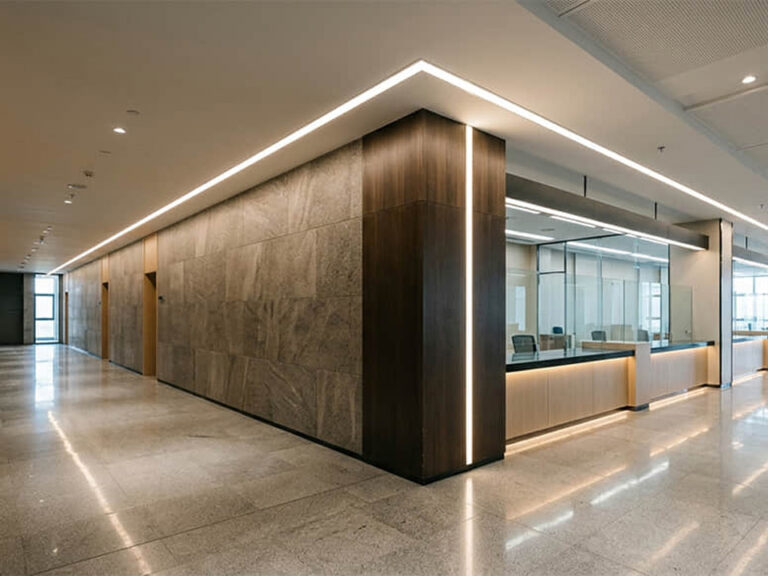
First, there is orientation lighting. People need to enter, read the space, find the reception desk, see elevators, identify corridors, and avoid awkward shadows. This is where LED ceiling lights for lobby areas need predictable uniformity, clean trim detail, and enough vertical illumination to make the room feel safe.
Second, there is identity lighting. This is where high CRI matters more. Brand walls, artwork, plants, textured surfaces, wood panels, leather seating, uniforms, and reception finishes need color clarity. A CRI 80 fixture may pass in a back corridor. In a lobby, it often looks like procurement gave up.
Third, there is comfort lighting. Visitors look upward. Staff sit under the same ceiling for hours. A high-lumen downlight with a shallow optic can hit the eye like a small interrogation lamp. I do not care how efficient it is. If it annoys people, it is wrong.
So, how do we choose?
For general lobby ceilings, I would start with commercial LED ceiling lights that have a clean architectural aperture, stable CCT, and a beam angle matched to ceiling height. For entrances, reception fronts, and waiting zones, I would favor anti-glare construction. For brand walls and art, I would add adjustable high CRI accent lighting instead of trying to make fixed ceiling downlights do every job.
But here is the hard truth: one fixture type cannot carry a professional lobby by itself.
A decent lobby often needs layered lighting: recessed downlights, wall washing, accent spots, decorative pendants, linear details, and dimming scenes. If the ceiling plan shows only rows of identical downlights, I assume the design is undercooked.
The Energy Argument Is Real, But Do Not Weaponize It Against Quality
Energy matters.
The U.S. Department of Energy LED Lighting page states that ENERGY STAR-rated residential LEDs use at least 75% less energy and last up to 25 times longer than incandescent lighting, and it also notes that LEDs are directional, which helps recessed downlights because less light is trapped inside the fixture.
Commercial buyers like that sentence because it sounds like money.
But in lobby projects, energy efficiency should not become an excuse for ugly light. A high-CRI LED package may have slightly lower efficacy than a lower-CRI package. That trade-off is not automatically bad. In a lobby running 10, 12, or 16 hours per day, I still want efficient drivers and controls, but I will not sacrifice the whole visual identity of the entrance just to win a small lm/W argument on paper.
The smarter move is controls.
Berkeley Lab’s lighting controls meta-analysis reviewed 240 savings estimates from 88 sources and found average savings of 24% for occupancy controls, 28% for daylighting, 31% for personal tuning, 36% for institutional tuning, and 38% for combined approaches. That is not showroom gossip. That is lab-backed evidence.
GSA also put numbers behind the commercial building case. In its 2024 announcement on LED and controls guidance for federal buildings, GSA said lighting consumes between 10% and 25% of building electricity depending on the building age and system, LED conversions typically save 50% over a fluorescent baseline, and controls can save additional lighting energy.
So no, I would not tell a buyer to choose the cheapest CRI 90 LED ceiling lights. I would tell them to buy the correct fixture, then reduce waste with dimming, scheduling, occupancy logic, daylight response, and proper zoning.
The Specification Checklist I Would Actually Use
I do not trust vague lighting quotes.
If a supplier sends “20W, 3000K, CRI90, white finish” and nothing else, that is not a specification. That is a napkin note with a price attached. Serious commercial LED ceiling lights need more evidence, especially for lobby lighting design where the finished room will be judged by owners, tenants, guests, and brand teams.
Before choosing High CRI LED Ceiling Lights for lobby areas, I would ask for:
CRI Ra and R9 values
CCT options, usually 2700K, 3000K, 3500K, and 4000K
SDCM target, ideally ≤3 for commercial spaces and ≤2 for higher-end lobbies
Beam angles with photometric data
IES or LDT files for layout simulation
Driver brand and dimming compatibility
Flicker data or at least driver-level confirmation
Housing material and thermal design
Trim color and finish consistency
Cutout size, ceiling thickness range, and mounting method
IP rating if the lobby connects to humid entrance zones
Warranty terms and replacement-driver policy
Batch consistency commitment for reorder projects
And yes, I would request samples.
A sample does not tell the whole story, but it exposes cheap optics fast. Put the fixture in the ceiling height range you expect. Test it on skin, wood, stone, fabric, signage, and painted wall surfaces. Dim it. Look from the entrance. Look from the seating area. Look from behind the reception desk. If the fixture feels harsh in mockup, it will not become gentle after bulk installation.
Meagree’s commercial lighting quote preparation guide is worth linking here because buyers often ask for pricing before they have a reflected ceiling plan, fixture schedule, electrical drawings, control intent, quantity, or finish requirements. That is backwards. The quote gets cleaner when the brief gets cleaner.
Mistakes That Make “Best LED Ceiling Lights for Lobby” a Dangerous Search
The phrase “best LED ceiling lights for lobby” sounds simple, but search results often flatten the decision into brightness, price, and appearance. That is how poor projects start.
Here are the mistakes I would watch for.
Mistake 1: Treating CRI 90 as the Finish Line
CRI 90 is the floor for better lobby lighting, not the trophy. Ask for R9. Ask for TM-30 data if available. Ask whether the supplier can hold CCT consistency across the project quantity.
Mistake 2: Ignoring Glare Because the Render Looks Nice
Architectural renderings lie by omission. They rarely show discomfort. In real life, a shallow high-output downlight can create sparkle, veiling glare, and staff complaints. Anti-glare geometry matters.
Mistake 3: Using One CCT Everywhere
A 4000K lobby can look clean in some offices and cold in hospitality. A 2700K lobby can feel warm in a boutique hotel and too yellow in a corporate headquarters. I usually start at 3000K or 3500K, then test against the actual material board.
Mistake 4: Buying Without Photometrics
No IES file, no trust. That may sound harsh, but a supplier selling commercial LED ceiling lights should be able to support layout work. Without photometrics, beam spread and illuminance become guesswork.
Mistake 5: Forgetting the Reorder Problem
One lobby becomes five sites. Five sites become a rollout. Then the second batch arrives with a slightly different CCT, trim finish, lens texture, or driver behavior. That is when procurement discovers why cheap quotes are expensive.
For projects that may repeat across offices, hotels, retail branches, or property portfolios, I would also review Meagree’s Complete Commercial LED Lighting Buying Guide because repeatability is not a catalog feature. It is a supplier discipline.
FAQs
What are High CRI LED Ceiling Lights?
High CRI LED Ceiling Lights are ceiling-mounted LED luminaires with strong color-rendering performance, usually CRI 90 or above, designed to show surfaces, materials, skin tones, signage, and interior finishes more accurately than standard CRI 80 fixtures in commercial environments such as lobbies, offices, hotels, galleries, and reception areas.
In lobby areas, I would not stop at CRI alone. Ask for R9, CCT, SDCM, beam angle, glare control, dimming behavior, and photometric files before approving the fixture.
Are CRI 90 LED ceiling lights good enough for lobby areas?
CRI 90 LED ceiling lights are usually good enough for many lobby areas, but they should be treated as a baseline rather than a complete specification because visual quality also depends on R9 red rendering, CCT, beam distribution, glare control, dimming compatibility, fixture placement, and material response under real conditions.
For premium hospitality, luxury retail, corporate headquarters, and design-heavy reception spaces, I would push for CRI 95, stronger R9, and mockup testing before final approval.
What color temperature is best for LED ceiling lights for lobby use?
The best color temperature for LED ceiling lights for lobby use is usually 3000K or 3500K, because these CCTs balance warmth, professionalism, facial comfort, and material accuracy better than very warm 2700K or colder 4000K options in many commercial reception and entrance environments.
That said, the material palette decides the final answer. Stone, wood, brass, black metal, white walls, plants, signage, and daylight exposure can all shift what looks correct.
How do I choose high CRI LED downlights for a commercial lobby?
To choose high CRI LED downlights for a commercial lobby, specify CRI 90+, request R9 data, select a CCT that matches the interior palette, confirm low-glare optical design, review IES/LDT photometric files, test dimming compatibility, and verify SDCM consistency before approving samples or bulk production.
I would also compare recessed depth, trim finish, beam angle, ceiling cutout, driver access, warranty language, and reorder stability. These are the details that separate a project-grade fixture from a catalog placeholder.
Do high CRI LED ceiling lights use more energy?
High CRI LED ceiling lights can use slightly more energy than lower-CRI LEDs because richer spectral output may reduce efficacy, but the difference can often be managed through better fixture selection, efficient drivers, beam control, zoning, dimming, daylight response, and occupancy-based controls in commercial lobby applications.
My opinion: do not sacrifice lobby color quality just to chase the highest lm/W number. Buy efficient high-CRI fixtures, then use controls intelligently.
Your Next Steps: Specify the Light Before You Ask for the Price
Do not send a supplier one sentence and expect a professional lobby result.
Send the reflected ceiling plan, ceiling height, lobby photos or renderings, finish board, target CCT, CRI/R9 requirement, beam preference, dimming protocol, quantity, installation region, compliance needs, and project deadline. Then ask for a documented recommendation, not just a unit price.