Still Not Seeing the Right Commercial Lighting Solution? Talk to Our Project Team.
If you have reviewed the website or already discussed options with sales but still need a clearer direction, send your request here. Our team will review your application, target specifications, and project constraints, then reply with a practical next step: what fits, what needs confirmation, and the fastest route to a quote and spec-ready files for your project.
Direct review of your application, specs, and project constraints for a clearer quote path.
Product matching across beam angle, CCT / CRI, drivers, dimming, and controls options.
Project documentation support, including cut sheets, wiring notes, and IES / LDT files where available.
OEM / ODM guidance for labels, packaging, housing finish, and private-brand requirements.
Get a Fast Quote for Commercial LED Lighting
Built for designers, architects, contractors, wholesalers, and project buyers. Share your application, quantity, and target specifications to get factory-direct pricing, lead-time guidance, and spec-ready support for US and EU projects.
Retail vs Office vs Hospitality Lighting: What Changes in Fixture Selection
One H1, Three Completely Different Jobs
Specs get lazy. Too many project teams still treat retail, office, and hospitality lighting as if they were the same ceiling problem with different furniture below, even though each sector is solving a different commercial problem, running on a different occupancy pattern, and getting judged by a different kind of failure. Why would the fixture logic stay the same?
Here is the hard truth I have learned after reading far too many submittals: most bad commercial lighting fixture decisions are not design mistakes first, they are business-model mistakes first. In a store, the fixture has to create focus and sell product; in an office, it has to reduce strain over long task hours and react to irregular occupancy; in a hotel, it has to flatter finishes, skin tones, and surfaces while still surviving housekeeping, dimming cycles, and guest misuse. According to the U.S. Energy Information Administration, lighting accounted for about 10% of total U.S. commercial-building energy use in 2018, while the U.S. Department of Energy says lighting still represents roughly 15% to 20% of building electricity use; DOE’s Interior Lighting Campaign also reported more than 2.8 million upgraded fixtures and controls, average energy cuts of 54%, and $68 million in energy-bill savings. That is not décor talk. That is operating-margin talk.
When I reviewed the structure of Meagree’s site, one thing stood out: the internal architecture already separates the problem the right way. The commercial LED lighting solutions page frames office, retail, and hospitality as different application environments; the track lighting for retail display section is built around adjustable directional lighting for shops and showrooms; the LED linear lighting systems page leans into clean, uniform light for offices and corridors; and the commercial LED lighting case studies page spans hospitality, retail, mixed-use, and office-linked references instead of pretending one product family fits every brief. That is the right starting point.
Table of Contents
Retail Lighting: Contrast Sells, Flat Light Kills
Retail wants drama. When buyers force office-style uniformity onto a sales floor, they usually get an evenly lit failure in which shelves, mannequins, packaging, and textures all sit at the same visual volume, which feels safe in a spreadsheet and dead in real life. Why do so many retail specs still reward flatness?
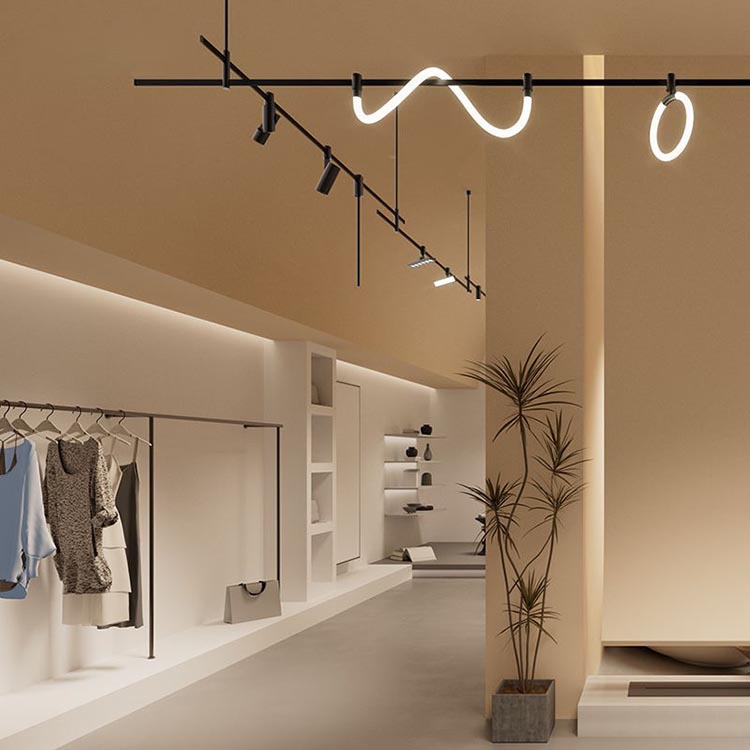
I do not start retail with ambient lighting. I start with focal hierarchy, beam control, and vertical illumination, because shoppers do not buy from horizontal lux averages; they buy from what their eyes land on first. The DOE has long noted that directional lamps such as MR16-type sources matter in retail and hospitality because beam control, flexibility, and compact form factor are central to focal lighting, and research published through Sheffield Hallam University argued that lighting is one of the atmosphere variables that shapes consumer perception and behavior in retail environments. That is why a store normally leans toward adjustable spot and track systems, tighter beam options like 12°, 24°, or 36° where needed, CRI 90+ for merchandise honesty, and selective ambient fill instead of blanket illumination.
On Meagree’s site, the logic is pretty direct. The track lighting for retail display category is described around adjustable directional lighting for shops, showrooms, and galleries, and the company’s specific LED track spotlight for retail display lighting page is framed for retail, showroom, gallery, boutique, and hospitality interiors. I would use that kind of fixture family when the planogram moves, the merchandising wall changes every quarter, or the hero product margin is too high to leave under broad, lazy ambient light.
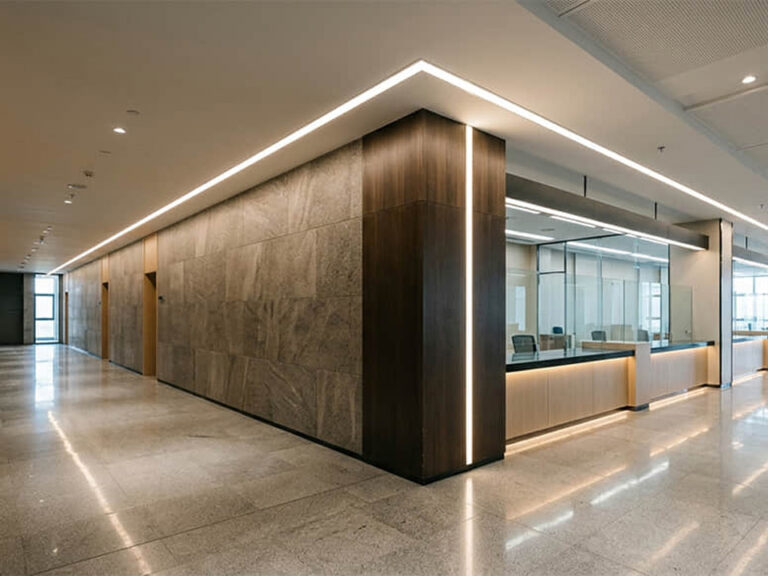
But retail is not only about spotlighting. And this is where cheap specs go wrong. Large-format stores, boutiques with perimeter shelving, and branded chains often need a second layer of clean background light so focal beams do not float in visual darkness, which is where LED linear lighting systems become useful for aisles, perimeter runs, cash-wrap zones, and retail ceilings that need cleaner lines without abandoning display contrast. The winning retail spec is rarely “all track” or “all downlight.” It is a controlled mix.
Office Lighting: Comfort, Controls, and Boring Reliability
Office punishes glare. The office category has changed more than many manufacturers admit, because the old assumption of five-day, fully occupied, fully lit floorplates no longer matches how a lot of buildings are actually used, which means fixture selection now lives or dies on control zoning, daylight response, low visual fatigue, and maintenance stability across half-full and peak-day conditions. Why would we still spec offices as if every desk is occupied from 8:00 to 18:00?
The business case has moved. Reuters reported that McKinsey estimated hybrid work could wipe $800 billion from office property values in major cities by 2030, and Kastle’s live office barometer has continued to show occupancy patterns that are nowhere near old full-time assumptions. So I do not want office fixtures that only look good at full output and full occupancy; I want fixtures that dim smoothly, zone cleanly, integrate with occupancy and daylight controls, and stay visually calm over screens, meeting rooms, circulation paths, and collaboration pockets.
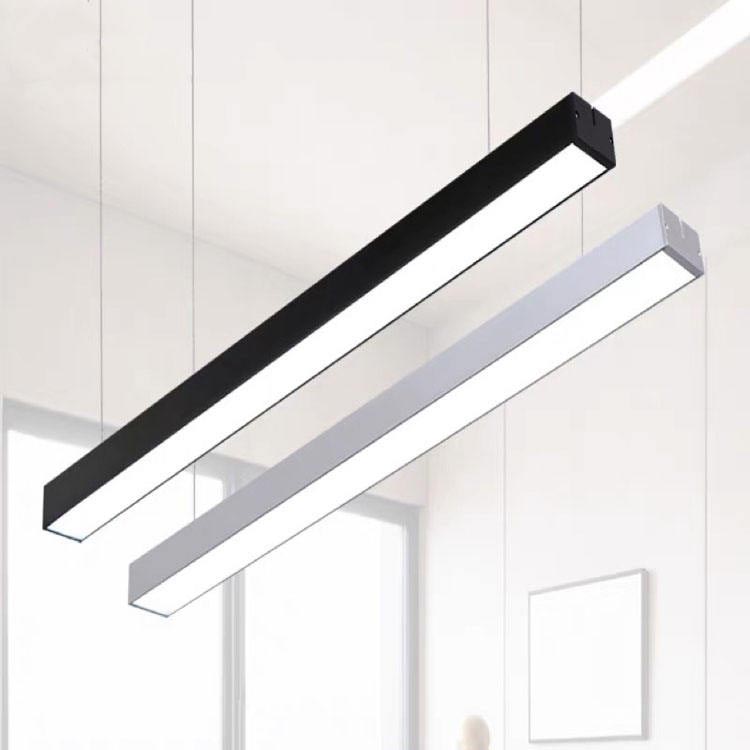
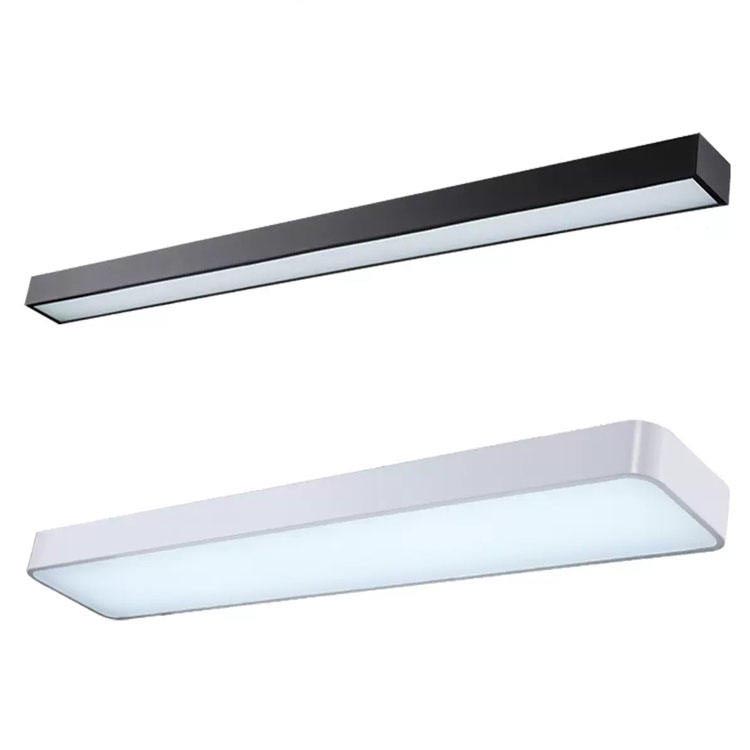
This is why office fixture selection usually shifts toward low-glare linear systems, disciplined downlights, or high-performance troffers rather than merchandise-style accent tools. Meagree’s LED linear lighting systems page explicitly positions linear fixtures for offices, corridors, and modern commercial spaces, while its office and lobby downlight options page is built around reliable everyday illumination for cleaner interiors. I would treat those as baseline office families, then decide whether the project needs suspended linear, recessed linear grille, deep-recessed downlight, or a hybrid ambient/task strategy based on screen density, ceiling height, reflectance, and maintenance access.
The performance benchmarks are not subtle anymore. DOE’s FEMP commercial and industrial LED luminaires guidance lists minimum efficacy thresholds such as 131 lm/W for linear ambient luminaires, 123 lm/W for 2×2 troffers, and 140 lm/W for 2×4 troffers, and it notes that compliant products can save more than $135 in lifecycle cost versus less efficient models. That is why I am skeptical of office specs that obsess over unit price while ignoring efficacy, controls, driver quality, and tuning capability; the cheap fixture is often the expensive one once the floor is occupied, recommissioned, and maintained.
And the case-study evidence is blunt. In the Byron G. Rogers Federal Building case study, GSA replaced 3,300 troffers with LED dedicated troffers and advanced controls, cutting annual lighting energy from 814,200 kWh to 337,200 kWh, or about 59%, in a 791,000-square-foot office building. That is what happens when office lighting is treated as a controls-and-comfort system, not as a commodity ceiling accessory.
Hospitality Lighting: Mood Has to Work at 6 a.m.
Hotels sell feeling. But hospitality lighting fails the moment it becomes pure theatre, because guest rooms, corridors, lift lobbies, vanity zones, restaurants, and reception desks all need atmosphere, orientation, facial accuracy, dimming stability, and maintenance sanity at the same time. Who wants a stunning lobby and a miserable bathroom mirror?
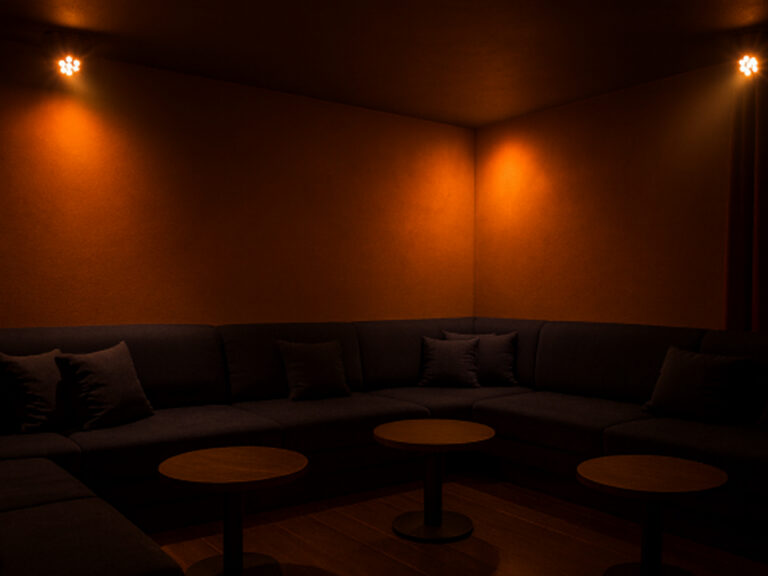
I am opinionated here. Hospitality is where the industry’s fake sophistication shows up fastest, because people love warm CCT and decorative sparkle but forget flicker, beam edge, glare, driver noise, and control logic. In practice, hospitality fixture selection is layered: recessed downlights for ambient structure, accent spotlights for material and focal cues, decorative luminaires where the brand needs a visual signature, and corridor/transition fixtures that do not blast guests in the face at midnight. That is exactly why anti-glare downlights for hotel corridors make more sense than generic shallow downlights in many hotel circulation zones.
The Hilton Columbus Downtown case is a useful reality check. DOE’s Better Buildings materials say the 532-room hotel was designed to be 32% more efficient than ASHRAE 90.1-2007, and the guest-room installation used more than 3,700 LED downlights across 484 rooms and 48 suites. DOE’s longer-term field evaluation also found that the dedicated LED downlights were driven primarily by architectural and lighting-design goals, improved light distribution and quality over the incumbent technologies, gave guests more control, and delivered meaningful energy and operational savings. That is hospitality in one sentence: the light has to look better, feel better, and still behave like an asset.
This is where buyers should stop pretending “hospitality” is one fixture recipe. Guest-room bedside reading, vanity lighting, corridor guidance, restaurant mood, and lobby statement lighting are different use cases wearing the same brand badge. If I were narrowing a hotel package on Meagree’s site, I would pair anti-glare downlights for hotel corridors with selected high-CRI recessed accents and then compare that shortlist against the actual hospitality references on the commercial LED lighting case studies page, which includes Shangri-La Hotel Chengdu and Baiman Hotel Shanghai alongside mixed-use and retail references. That is a smarter move than buying from a render.
The Fixture Selection Table I’d Use Before Approving Any Spec
This is the matrix I would put in front of any procurement manager, lighting designer, or project engineer before approving a lighting fixture selection package, because it forces the team to match the fixture to the business outcome instead of hiding behind a generic “commercial LED lighting” label. The sector logic below is consistent with DOE guidance, code trends, and the way Meagree has separated product families and project references across retail, office, and hospitality.
Space Type
Main Goal
Fixture Bias
Typical Optics Logic
Color Strategy
Controls Priority
What Usually Breaks the Project
Retail
Sell merchandise and guide attention
Track spots, accent heads, selective linear ambient
Narrow to medium beams for focal hierarchy, flexible aiming for display change
Usually high CRI, often 3000K–3500K depending on merchandise
Scene changes, regrouping, relighting flexibility
Flat ambient light that erases contrast
Office
Reduce strain and support flexible occupancy
Linear systems, troffers, disciplined downlights
Wide, even distribution with restrained brightness
Consistent white light, typically neutral for task visibility
Occupancy sensing, daylight dimming, task tuning
Glare, overlighting, wasted burn hours
Hospitality
Create mood without losing usability
Recessed downlights, accents, decorative layers
Layered beams for ambience, wayfinding, and focal highlights
Warm, flattering light with strong color rendering
Guest control, dimming quality, scene stability
Beautiful concept, poor real-world comfort
Codes and Controls Are Now Part of Fixture Selection, Not a Footnote
Codes got sharper. If your fixture schedule still treats controls as a separate add-on and compliance as somebody else’s problem, you are not simplifying the project, you are pushing cost and risk downstream into commissioning, redesign, and failed expectations. Why do teams still act as if controls are optional garnish?
The current code and standard direction is obvious. ASHRAE’s summary of Standard 90.1-2022 lighting changes says the update tightened lighting power values and expanded control requirements, and California’s nonresidential indoor lighting guide shows how much more specific the control conversation has become, including partial-on behavior at 50% to 70% of controlled lighting power in certain sensor-driven applications and 50% reduction requirements for office, hotel/motel, and retail lighting alterations. So yes, the fixture still matters. But the fixture without the right control profile is now an incomplete spec.
I will say it plainly: the sector shift is not “retail uses track, office uses linear, hotel uses warm downlights.” That is entry-level thinking. The real shift is that retail needs controlled emphasis, office needs controllable restraint, and hospitality needs emotional layering with operational discipline. Different business models. Different failure modes. Different commercial lighting fixtures.
FAQs
What is the main difference between retail, office, and hospitality lighting fixture selection?
The main difference is that retail lighting fixture selection is driven by visual hierarchy and merchandise emphasis, office lighting fixture selection is driven by comfort, control, and task visibility, and hospitality lighting fixture selection is driven by atmosphere, guest usability, and layered scene-setting across multiple touchpoints.
That is why one fixture family almost never wins across all three sectors. Even when wattage looks similar, the beam logic, glare tolerance, dimming expectation, and control strategy are not.
Are track lights only for retail lighting?
Track lights are not only for retail lighting, but they are most valuable where display focus, adjustable aiming, frequent layout change, and visual emphasis matter more than perfect uniformity, which is why they show up most naturally in stores, galleries, showrooms, boutiques, and selected hospitality feature zones.
I would not default them into a desk-heavy open office, but I would absolutely use them in a hotel feature wall, reception zone, or branded retail perimeter where fixed downlights would be too rigid.
What matters more in commercial lighting fixtures: efficacy or controls?
In commercial lighting fixtures, efficacy and controls work as a pair, because a high-lm/W luminaire lowers the base energy demand while a good control strategy cuts unnecessary operating hours, trims overlighting, and adapts output to real occupancy, daylight, schedules, and scene requirements.
I do not trust specs that brag about one and ignore the other. That is how people buy efficient hardware and operate it inefficiently for the next seven years.
How should a buyer compare lighting suppliers for office, retail, and hotel projects?
A buyer should compare lighting suppliers by application fit, photometric evidence, control compatibility, quality consistency, lead-time reliability, and proof from comparable projects, rather than by catalog breadth or unit price alone, because the real cost shows up later in glare complaints, color mismatch, driver failure, and respec work.
That is why I would ask for application-matched product pages, IES/LDT files, dimming details, CRI/CCT binning clarity, and relevant project references before I sign off on a shortlist.
Your Next Step
Start smaller. Pick one retail bay, one office zone, or one guest-room prototype, then force every shortlisted fixture to answer the same ugly questions: What is the beam doing on the vertical surface? What happens at 10% dimming? What does the space look like at 6:00 a.m. and 9:00 p.m.? What is the maintenance path? What is the control logic? And does the supplier have proof outside a render?