Still Not Seeing the Right Commercial Lighting Solution? Talk to Our Project Team.
If you have reviewed the website or already discussed options with sales but still need a clearer direction, send your request here. Our team will review your application, target specifications, and project constraints, then reply with a practical next step: what fits, what needs confirmation, and the fastest route to a quote and spec-ready files for your project.
Direct review of your application, specs, and project constraints for a clearer quote path.
Product matching across beam angle, CCT / CRI, drivers, dimming, and controls options.
Project documentation support, including cut sheets, wiring notes, and IES / LDT files where available.
OEM / ODM guidance for labels, packaging, housing finish, and private-brand requirements.
Get a Fast Quote for Commercial LED Lighting
Built for designers, architects, contractors, wholesalers, and project buyers. Share your application, quantity, and target specifications to get factory-direct pricing, lead-time guidance, and spec-ready support for US and EU projects.
Most Common Fixture Selection Mistakes in Commercial LED Lighting Projects
Table of Contents
The Ugly Truth: Most Bad Lighting Projects Look “Fine” on Paper
I have seen fixture schedules that looked clean, polished, and procurement-ready. Then the building opened.
Pain arrived fast.
The lobby had glare from deep ceiling downlights, the retail display washed out product colors, the office linear lights flickered under dimming, and the contractor got blamed even though the real mistake happened weeks earlier, when someone selected commercial LED lighting fixtures by wattage, price, and housing shape instead of optical performance, installation conditions, and verified testing data.
And honestly, why does this still happen?
Because commercial LED lighting is sold like a commodity, but it performs like an engineered system. The U.S. Energy Information Administration says lighting accounted for about 17% of electricity consumption in U.S. commercial buildings in 2018, equal to 208 billion kWh, so bad fixture selection is not a decorative mistake; it is an operating-cost mistake with a long tail. See the EIA lighting electricity data.
Mistake #1: Choosing Wattage Before Beam Control
Here is the industry’s dirty little habit: buyers still ask for “20W downlights” before they ask for beam angle, candela, spacing, mounting height, or visual task.
That is backwards.
A 20W commercial LED downlight with a 15° narrow beam is not the same product as a 20W wide-beam downlight, even if both sit in the same spreadsheet cell. One creates punch. One creates ambient spread. One can make a hotel corridor look intentional. The other can make it look like a cheap basement retrofit.
When teams ask “how to choose commercial LED fixtures,” my answer is blunt: start with the surface you need to light, not the fixture you want to buy. Retail shelving, supermarket fresh food zones, hotel corridors, office workstations, and gallery walls all need different beam distributions.
For interior projects that need recessed comfort and controlled distribution, it makes sense to compare LED downlights for commercial interiors against track heads or spotlights before locking the schedule. Downlights are often treated as default ambient tools, but in many commercial lighting projects, they are being asked to do accent work they were never designed to do.
The Beam-Angle Reality Check
Project Area
Common Wrong Choice
Better Selection Logic
What to Request Before Approval
Retail display wall
Wide beam fixture because it “covers more”
Narrow or medium beam with controlled aiming
IES/LDT file, beam angle, center beam candlepower
Hotel corridor
High-lumen downlight with shallow cutoff
Deep anti-glare downlight with lower glare
UGR estimate, cut-off angle, trim finish
Open office
Random panel or linear fixture by wattage
Linear lighting with spacing, diffuser, and glare review
Layout plan, lumen output, driver/dimming data
Restaurant table zone
Flat ambient lighting everywhere
Layered downlight, spotlight, or pendant strategy
CCT, CRI, beam spread, dimming curve
Supermarket aisle
Same fixture across all departments
Different optics for aisle, produce, meat, bakery
CRI/R9, photometrics, mounting height study
Mistake #2: Treating “High Lumen” as a Quality Signal
More lumens can mean more waste.
I know that sounds inconvenient, especially when a tender document rewards the biggest number at the lowest price, but a fixture that dumps light into the wrong zone is not “efficient.” It is just loud. Visually loud. Electrically loud. Maintenance loud.
The U.S. Department of Energy estimated that LED adoption saved 1.3 quadrillion Btu in 2018, worth about $14.7 billion for consumers, and also noted that low/high bay and linear fixtures are major sources of potential savings in commercial and industrial buildings. Read the DOE LED Adoption Report.
But here is the hard truth: those savings depend on selecting the right luminaire, not merely swapping old fixtures for LED versions. A 150 lm/W fixture with poor optics may lose the project to glare complaints, re-aiming labor, extra dimming controls, or even replacement.
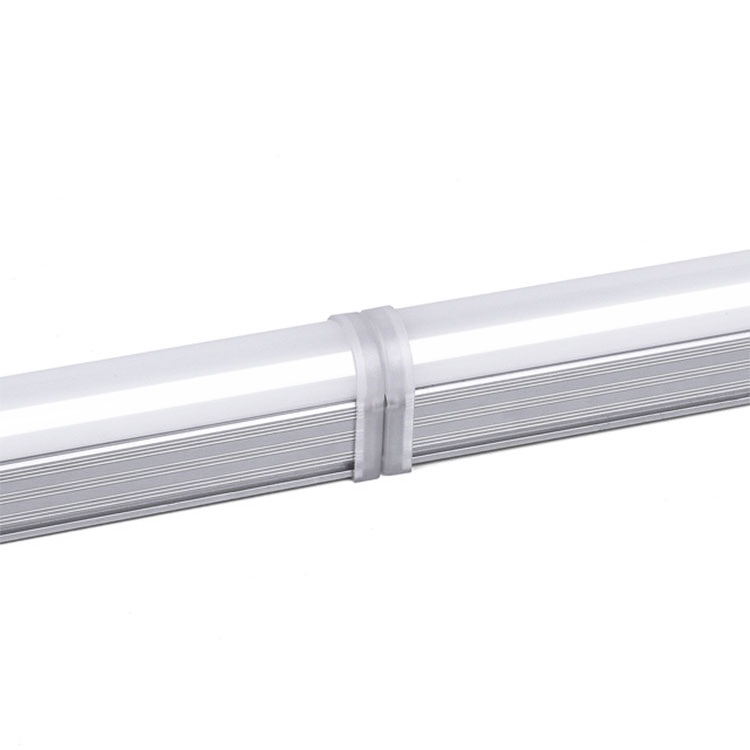
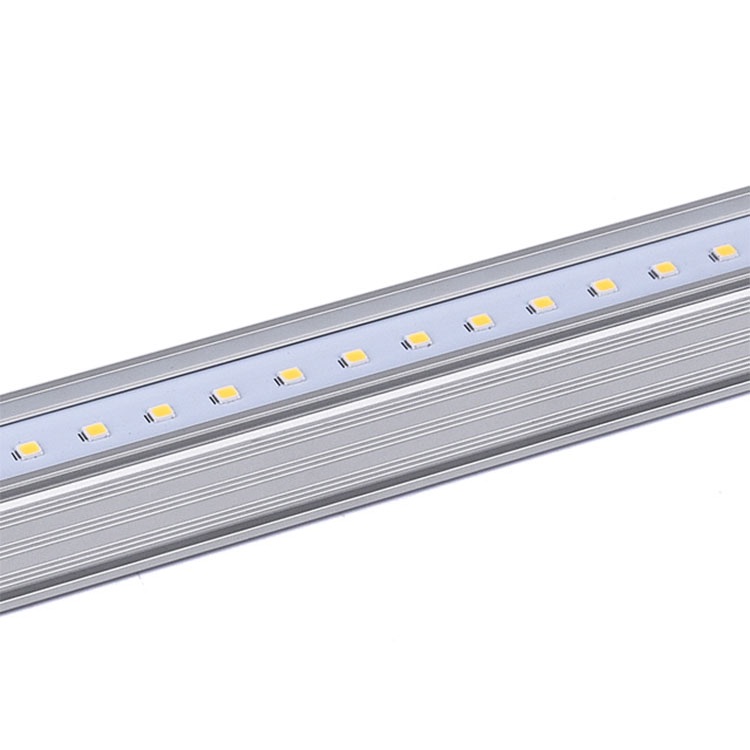
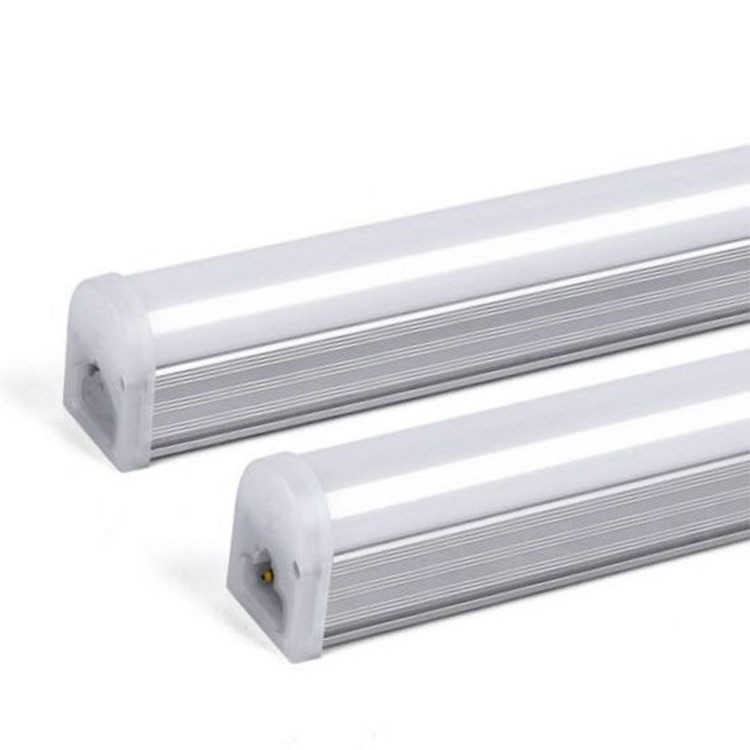
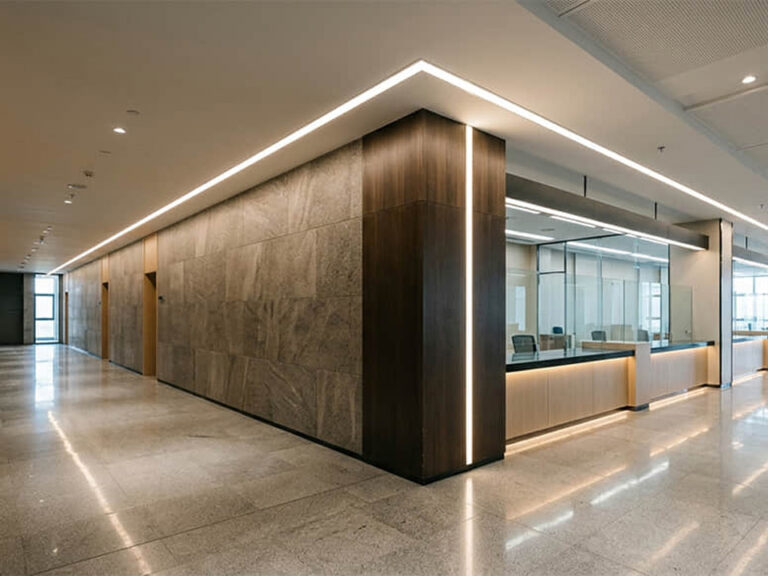
That is why LED linear lighting for offices and commercial ceilings should be evaluated by diffuser quality, glare control, length, wattage, installation style, and spacing ratio, not just lumen output. A neat-looking linear run can still fail if the lens produces harsh brightness at eye level.
Mistake #3: Ignoring Glare Until Occupants Start Complaining
Glare is where cheap fixtures hide their sins.
A supplier can polish a catalog photo, inflate a lumen claim, and write “anti-glare” on a product page. But glare lives in the room, not in the brochure. It appears when a guest looks down a corridor, when a cashier stands under the same ceiling grid for eight hours, when a hotel lobby uses glossy stone, or when a meeting room puts bright downlights directly over faces.
The mistake is not choosing LEDs. The mistake is selecting commercial LED lighting fixtures without asking where the eye will be.
For hospitality, retail, and office interiors, use anti-glare optics, recessed light source designs, matte reflectors, black or low-brightness baffles where appropriate, and realistic mockups when the budget allows. For display zones, LED track lighting for retail and showroom applications can be a smarter choice than fixed ceiling fixtures because it gives the team aiming flexibility after merchandising changes.
But here is my unpopular view: many “best LED fixtures for commercial buildings” lists are nearly useless because they rank fixture types without the room geometry. A good track light in the wrong ceiling position is still a bad lighting decision.
Mistake #4: Trusting Lifetime Claims Without Asking What Was Actually Tested
A 50,000-hour claim can be honest. It can also be decorative fiction.
The Federal Trade Commission went after Lights of America for exaggerated LED bulb claims, and a federal court ordered more than $21 million over misleading light output and life expectancy claims. That case is old, yes, but the lesson is still alive: unsupported LED performance claims are not harmless copywriting. They can become financial risk. Read the FTC court order on misleading LED claims.
This matters in commercial LED fixture selection because many buyers still confuse LED chip data with full fixture reliability. LM-80 data may describe LED package lumen maintenance. TM-21 may project lumen maintenance. LM-79 may report full luminaire photometric and electrical performance at a point in time. None of that automatically proves the driver, thermal path, optical material, soldering, housing finish, and waterproofing will behave perfectly in your actual project.
Small distinction. Big bill.
Before approving an industrial LED lighting fixture, ask for the documentation package: LM-79 where available, LM-80/TM-21 support, IES or LDT files, driver brand and model, surge protection level, dimming protocol, IP rating, IK rating if relevant, warranty terms, and test conditions. If the supplier cannot explain the difference between component life and luminaire life, slow down.
Mistake #5: Forgetting Drivers, Dimming, and Flicker
LED drivers are often where the project gets quietly poisoned.
The fixture looks good. The sample turns on. The price is fine. Then the installed system buzzes, flickers, steps badly at low dim levels, or refuses to play nicely with the control system. I have watched teams spend days diagnosing “bad lights” when the real issue was driver compatibility.
PNNL has studied flicker measurement and noted that 10% to 25% of the population may be sensitive to flicker, while badly flickering products can contribute to headaches, migraines, distraction, or malaise. Their work on the flicker phenomenon is exactly the kind of research buyers should keep in mind before treating driver choice as a minor line item.
So ask ugly questions early:
Is it 0-10V, DALI, Triac, PWM, or Casambi/Bluetooth control?
What happens below 10% dimming?
Is the flicker percentage or modulation depth available?
Has the driver been tested with the specified dimmer or control system?
Is the power factor acceptable for the project?
What is the total harmonic distortion?
And yes, this is where a serious OEM/ODM commercial LED lighting partner earns its money. Meagreelight’s OEM/ODM page describes support for PCB design, driver integration, photometric testing, thermal simulation, aging tests, waterproof testing, and high-temperature/humidity verification, which is the kind of engineering trail buyers should demand before mass rollout.
Mistake #6: Buying the Fixture Before Defining the Space
This happens constantly in commercial lighting project mistakes: the buyer selects the fixture first, then the designer tries to make the layout work around it.
That is not design. That is damage control.
For commercial LED lighting, application should drive selection. A supermarket fresh meat zone may need high CRI and strong R9 rendering. A boutique may need narrow-beam adjustable spotlights. A hotel corridor may need warm CCT, low glare, and consistent finish. A warehouse may need high-bay output, robust thermal design, surge protection, and safe maintenance access.
The EIA reported that LED bulbs were used in 44% of U.S. commercial buildings in 2018, up from 9% in 2012, and projected LEDs could provide up to 95% of commercial lighting needs by 2050. That adoption curve is massive, but it also means more bad specifications are being repeated at scale. See the EIA commercial LED adoption report.
If you are sourcing across retail, hospitality, office, supermarket, or exterior applications, start with the full commercial LED lighting product range and then narrow by application, not by whatever fixture family happens to be cheapest that week.
Mistake #7: Treating DLC, CE, RoHS, and Reports as Afterthoughts
Some buyers only ask for compliance documents when the shipment is already moving.
That is reckless.
The DesignLights Consortium says its Qualified Products Lists are verified lists of high-performing, energy-saving LED lighting solutions, and its QPL covers more than 80 categories of indoor and outdoor commercial LED products. It also says networked lighting controls can save up to 50% more energy than LED lighting alone. See the DLC Qualified Products Lists.
For North American utility rebate projects, DLC listing can affect incentive eligibility. For EU-facing projects, CE and RoHS documentation matter. For large rollouts, IES/LDT files matter because the designer or engineer needs to verify light distribution before the boxes arrive.
My rule is simple: if the report affects approval, rebate, installation, safety, or payment, it is not “paperwork.” It is part of the product.
Mistake #8: Ignoring Finish Consistency and Rollout Repeatability
The first sample is not the project.
In multi-site retail, hotel, supermarket, or office rollouts, the mistake is assuming one approved fixture guarantees the next 500 or 5,000 units will match. They may not. CCT bins shift. anodized finishes vary. Plastic diffusers change. Drivers get substituted. Lens suppliers change. Packaging damage appears. A 3000K fixture from batch one may not visually match batch three.
This is where procurement needs discipline, not optimism.
Ask for SDCM targets. Ask whether 3-step or 5-step MacAdam ellipse tolerance is being used. Ask how the factory controls LED binning, driver substitution, housing finish, aging tests, and final inspection. For buyers comparing suppliers, the quality control process should not be a polite page visit; it should become a checklist for purchase approval.
And if a supplier says, “Same quality, don’t worry,” I worry.
What I Would Demand Before Approving Commercial LED Lighting Fixtures
Below is the practical checklist I would use before signing off a commercial LED fixture selection.
Selection Area
Minimum Evidence I Want
Why It Matters
Optical performance
IES/LDT file, beam angle, lumen output, candela data
Prevents dark spots, hot spots, and wrong spacing
Visual comfort
UGR data where relevant, cutoff angle, anti-glare structure
Avoids flicker, buzzing, control failure, electrical issues
Thermal design
Heat sink structure, ambient rating, aging test
Protects lifetime and output stability
Compliance
CE, RoHS, FCC, DLC, LM-79, LM-80/TM-21 where applicable
Supports approvals, rebates, tenders, and market access
Supply control
Golden sample, batch inspection, packaging test
Reduces rollout inconsistency and site complaints
FAQs
What are the most common fixture selection mistakes in commercial LED lighting projects?
The most common fixture selection mistakes in commercial LED lighting projects are choosing by wattage instead of beam control, ignoring glare, trusting unsupported lifetime claims, overlooking driver compatibility, skipping photometric files, and failing to match fixture type to the real application, ceiling height, surface reflectance, and maintenance conditions.
In plain language, buyers often ask “How many watts?” when they should ask “Where does the light go?” That one change prevents a lot of expensive embarrassment.
How do you choose commercial LED fixtures for retail, office, and hospitality projects?
You choose commercial LED fixtures by defining the application first, then matching beam angle, lumen output, CCT, CRI, glare control, dimming method, installation type, IP rating, and documentation to the space rather than buying a generic fixture family based only on price, wattage, or catalog appearance.
Retail usually needs controlled accent lighting and strong color rendering. Offices need glare management and even visual comfort. Hospitality needs mood, warmth, finish consistency, and low-brightness optics.
Why is beam angle important in commercial LED fixture selection?
Beam angle is important in commercial LED fixture selection because it determines how light spreads from the luminaire onto shelves, floors, desks, walls, or architectural surfaces, directly affecting brightness uniformity, contrast, glare, spacing, energy use, and whether the selected fixture actually supports the design intent of the commercial space.
A 15° beam can create drama. A 60° beam can create broad ambient coverage. Neither is automatically better. The room decides.
What documentation should buyers request before approving LED lighting fixtures?
Buyers should request IES or LDT photometric files, LM-79 reports where available, LM-80 and TM-21 data for LED source evaluation, driver specifications, dimming compatibility details, CCT and CRI data, SDCM binning targets, IP/IK ratings where relevant, compliance certificates, warranty terms, and project-specific installation guidance.
If a supplier can only send a PDF catalog and a price list, that is not enough for serious commercial LED lighting procurement.
Are the best LED fixtures for commercial buildings always the most efficient ones?
The best LED fixtures for commercial buildings are not always the most efficient on a lm/W basis, because real project performance also depends on optics, glare control, color quality, driver reliability, thermal design, dimming behavior, compliance documentation, installation conditions, and whether the fixture can be supplied consistently across the full rollout.
Efficiency matters. But uncontrolled efficiency is just glare with a spreadsheet.
Your Next Steps
Before you approve the next commercial LED lighting fixture schedule, stop treating the fixture as a commodity and start treating it as a system: optics, driver, thermal path, controls, color, compliance, documentation, and repeatable production all need to line up.
Send the project application, mounting height, ceiling type, target CCT/CRI, dimming method, beam needs, quantity, and compliance market to Meagreelight’s team through the commercial LED lighting quote request page. Ask for the files before the price war begins. That is how professionals avoid the mistakes amateurs keep paying for.