¿Aún no encuentra la solución de iluminación comercial adecuada? Hable con nuestro equipo de proyectos.
Si ha consultado el sitio web o ya ha hablado de las opciones con el departamento de ventas pero sigue necesitando una orientación más clara, envíe su solicitud aquí. Nuestro equipo revisará su aplicación, las especificaciones de destino y las limitaciones del proyecto, y le responderá con un paso práctico: lo que encaja, lo que necesita confirmación y la ruta más rápida para obtener un presupuesto y archivos listos para las especificaciones de su proyecto.
Revisión directa de su solicitud, especificaciones y limitaciones del proyecto para obtener un presupuesto más claro.
Correspondencia de productos en cuanto a ángulo de haz, CCT / CRI, controladores, regulación y opciones de control.
Apoyo a la documentación del proyecto, incluidas hojas de corte, notas de cableado y archivos IES / LDT cuando estén disponibles.
Orientación OEM / ODM para etiquetas, embalaje, acabado de carcasas y requisitos de marca privada.
Obtenga un presupuesto rápido para Iluminación LED comercial
Diseñado para diseñadores, arquitectos, contratistas, mayoristas y compradores de proyectos. Comparta su aplicación, cantidad y especificaciones de destino para obtener precios directos de fábrica, orientación sobre plazos de entrega y soporte listo para especificaciones para proyectos en EE. UU. y la UE.
Opciones listas para presupuesto: haz / óptica, objetivos CCT / CRI / SDCM, controladores, regulación e integración de controles
Documentación del proyecto: hojas de corte, planos y archivos IES / LDT cuando estén disponibles.
Asistencia OEM / ODM: SKU de marca propia, envases, etiquetas, manuales y etiquetado listo para código de barras
Calidad estable para las implantaciones: SKU repetibles, puntos de control de calidad y suministro escalable para licitaciones y nuevos pedidos.
NDA disponible previa solicitud para planos detallados y archivos del proyecto
Mala difusión de las especificaciones. He visto a demasiados equipos obsesionarse con la potencia, el acabado y el coste unitario, mientras que nadie se molesta en plantear la única pregunta que decide si un maniquí, una botella, un cuadro, un menú o un expositor de productos resultarán caros bajo la luz: ¿cuál es la anchura del haz y qué alcanza a la altura real de montaje? ¿Por qué seguimos fingiendo que el ángulo del haz es una cuestión secundaria?
Esta es mi opinión. Confío más en el control del haz que en los lúmenes de los folletos, porque la luz que cae en el lugar equivocado no es “cobertura extra”, es desperdicio, deslumbramiento y confusión visual que lleva una etiqueta técnica. Según Guía ENERGY STAR para edificios comerciales, Según el Departamento de Energía de EE.UU., los LED podrían generar un ahorro anual de 569 TWh de aquí a 2035, por lo que las malas decisiones no sólo perjudican la presentación, sino que siguen costando dinero mucho después del traspaso.
Índice
Deje de fiarse de las etiquetas y empiece a leer los títulos
Las palabras van a la deriva. Un proveedor llama a 24° “medio”, otro lo llama “narrow flood”, y un tercero entierra la distribución real tras una bonita representación, que es por lo que me importa menos el adjetivo y más el número de grados, la altura de montaje y el tamaño objetivo in situ. ¿No es esa la única forma honesta de especificar un foco?
Las directrices federales son mucho más limpias que el marketing. En las directrices sobre LED de la GSA para edificios federales, de 8° a 15° se considera narrow spot, de 21° a 30° narrow flood y de 41° a 60° wide flood; mientras tanto, la investigación sobre deslumbramiento del DOE sigue recordando a los especificadores que la luminosidad aparente y el confort visual real no son lo mismo, especialmente una vez que la luminancia, el tamaño de la fuente y el ángulo de visión empiezan a jugar en su contra.
Esta es la regla práctica que utilizo. Trato proyector de haz estrecho especificaciones como aproximadamente 8°-15°, proyector de haz medio como aproximadamente 16°-30°, y proyector de haz extensivo especificaciones como aproximadamente 31°-60° para las conversaciones comerciales, admitiendo al mismo tiempo que los fabricantes no siempre utilizan el mismo lenguaje. Eso no es pureza académica. Eso es supervivencia.
Las matemáticas ayudan. El ángulo del haz no es mágico, y una vez que dejas de tratarlo como un misterioso instinto de diseñador, puedes estimar el diámetro del haz con una simple regla: el diámetro del haz es aproximadamente 2 × distancia de proyección × tan(ángulo del haz ÷ 2), lo que significa que la misma luminaria se comporta de forma muy diferente a 2,7 m, 3 m o 4,5 m. ¿Por qué adivinar cuando la geometría es más barata que una llamada de retorno?
Utilizando una altura de montaje de 3 m como punto de referencia limpio, esto es lo que realmente hacen las tres bandas de trabajo en la práctica:
Tipo de haz
Banda de titulación práctica
Diámetro aproximado del haz a 3 m
Lo que mejor hace
Lo que suele fallar
Estrecho
8°-15°
0.42-0.79 m
Joyería, arte, maniquíes, botellas de héroes, expositores de nicho
Puntos calientes, festones y errores de puntería brutales
Medio
16°-30°
0.84-1.61 m
Estanterías, mesas auxiliares, trabajos de acento en general, venta al por menor flexible
Se vuelve soso si se utiliza en todas partes
Ancho
31°-60°
1.82-3.46 m
Gráficos murales, grandes expositores, señalización amplia, lavados suaves
Escenas planas, luz derramada, contraste reducido, más quejas por deslumbramiento
Esas bandas no son una religión. Son un lenguaje de especificaciones de trabajo que se ajusta a las directrices de distribución de la GSA y, al mismo tiempo, las traduce a lo que los compradores, diseñadores e instaladores realmente necesitan saber in situ.
Donde lo estrecho gana, donde lo medio te salva, donde lo ancho fracasa
Proyector de haz concentrado: la herramienta del cirujano
Utilízalo con cuidado. Cuando el objeto tiene un margen, un valor emocional o una jerarquía visual, recurro a un foco de haz estrecho, porque un haz de 10° o 12° puede hacer que un bolso, una escultura, una etiqueta de vino o un detalle de la recepción parezcan deliberados en lugar de accidentales. Pero, ¿realmente quieres ese tipo de agresión óptica en la pared de una estantería desordenada?
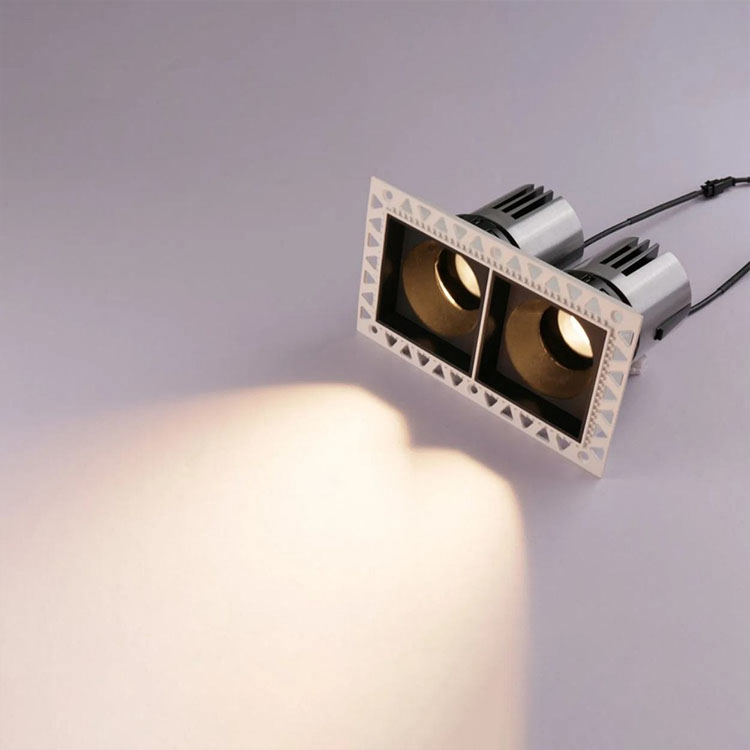
Aquí es donde muchas especificaciones se vuelven embarazosas. Los equipos compran una “viga estrecha” porque suena bien, luego la montan demasiado alta, apuntan demasiado a la ligera y se preguntan por qué el suelo brilla más que la mercancía. Si el objetivo es un control estricto, se necesita una disciplina estricta. Ahí es exactamente donde un modelo como el de Meagree Proyector LED regulable de 12 W para iluminación de escaparates o una más flexible Proyector LED COB de carril para iluminación de acento de expositores tiene sentido, porque la flexibilidad de apuntamiento importa tanto como la anchura del haz una vez que cambia la pantalla.
Foco de haz medio: el adulto en la habitación
Esta es mi opción por defecto. Un foco de haz medio, normalmente entre 20° y 30°, es la respuesta menos glamurosa y, a menudo, la más inteligente, porque ofrece suficiente concentración para crear foco, suficiente anchura para evitar ridículos puntos calientes y suficiente tolerancia para tolerancias de instalación normales. ¿Por qué la industria sigue siendo tan adicta a los extremos cuando los haces medios resuelven más proyectos reales?
He visto cómo las vigas medianas salvaban instalaciones de venta al por menor que las vigas estrechas habrían sobredramatizado y las vigas anchas habrían aplanado. Son especialmente adecuadas para estanterías, mesas de marca, mostradores de comida y bebida y zonas de boutique en las que la exposición es importante pero no singular. Si el proyecto también necesita un contexto más amplio sobre la lógica de aplicación, el adyacente retail vs office vs hospitality fixture selection página es el siguiente paso interno correcto, porque el ángulo del haz sólo tiene sentido cuando la función empresarial de la sala está clara.
Foco de haz extensivo: útil, pero más peligroso de lo que la gente admite
Amplio no es suave por defecto. Un proyector de haz extensivo puede resolver absolutamente el problema adecuado al cubrir de forma más uniforme gráficos más grandes, estantes más anchos, paredes con textura o superficies orientadas hacia los clientes, pero también destruye el contraste más rápido de lo que a los especificadores les gusta admitir, y una vez que el contraste desaparece, la sala deja de indicar a la gente dónde mirar. ¿Se trata realmente de una “mejor cobertura” o sólo de una iluminación perezosa con un mejor argumento de venta?
Soy aún menos indulgente al aire libre o en zonas perimetrales. Reuters informó el 8 de abril de 2026 que la luz nocturna mundial aumentó 16% de 2014 a 2022, mientras que el DOE sigue destacando el deslumbramiento como una consecuencia real de la adopción de LED, especialmente cuando las fuentes brillantes están mal controladas en entornos oscuros. Así que sí, los haces anchos tienen un lugar, pero los haces anchos más un apantallamiento descuidado más una mala orientación es cómo la iluminación de acento se convierte en derrame, resplandor y quejas de los ocupantes. Eso ya no es teoría.
Las tres variables que los representantes de ventas siguen ignorando
La altura de montaje lo cambia todo
La distancia miente. Un haz de 15° puede parecer muy preciso a una altura del techo y completamente inadecuado a otra, por lo que no apruebo los programas de proyectores hasta que no veo la distancia de proyección, las dimensiones del objetivo y la intención de apuntar en una hoja. ¿Por qué alguien aprobaría una óptica sin esas tres cifras?
Por eso los consejos de una página sobre el “mejor ángulo de haz” no suelen tener sentido. El mismo ángulo de haz nominal puede funcionar para una torre de visualización de 1,2 m y fallar en una pared de 3,6 m, porque la dispersión del haz, el apuntamiento vertical y la reflectancia del objetivo no importan lo que el folleto quería venderle.
El deslumbramiento no es un efecto secundario
La gente sigue hablando del deslumbramiento como si fuera un problema menor de comodidad. Creo que es una pereza, porque el deslumbramiento altera el tiempo de permanencia, la fatiga visual, la legibilidad de la mercancía y la calidad percibida de toda la sala, y las investigaciones respaldadas por el DOE siguen insistiendo en este punto estudiando el efecto de la posición de la fuente, la intensidad, el tamaño y la luminancia de fondo sobre la incomodidad. ¿Por qué gastamos tanto en acabados y luego toleramos una mala disciplina de luminancia?
Los controles dejan al descubierto los puntos débiles
Aquí viene otra dura verdad. Si las especificaciones de un proyector dependen de escenas, reajustes de merchandising o control de ambiente de hospitalidad, entonces “regulable” no es una respuesta real hasta que se nombre el controlador, el protocolo y el comportamiento probado, porque los controles son donde las luminarias de oferta revelan su verdadera personalidad. ¿Por qué los compradores siguen aceptando vagas afirmaciones de regulación en 2026?
El artículo del DOE del 10 de enero de 2024 sobre el control de 0-10V examinó 23 farolas LED que afirmaban ser regulables, documentó la variación real del rendimiento en los controladores disponibles en el mercado y vinculó la cuestión a la norma ANSI C137.1-2022. La lección se traslada directamente a los focos de interior: un buen ángulo de haz combinado con un control inestable sigue siendo una mala especificación.
Mi regla básica para elegir el mejor ángulo de haz de los focos
Empieza a estrecharse sólo cuando el objetivo merezca jerarquía. Si el objeto es el héroe, el rayo debe comportarse como si lo supiera.
Cambie a la posición media cuando cambie la exposición. La mayoría de los proyectos comerciales reales necesitan adaptabilidad más que bravuconería teatral, y las vigas medias toleran la deriva ordinaria del merchandising sin que el techo parezca incompetente.
Aplíquelo sólo cuando sea la superficie, y no el objeto, lo que cuenta. Los lavados amplios son adecuados para gráficos, texturas, énfasis perimetral y fondos más grandes, no para todas las superficies comerciales solo porque alguien quiera menos accesorios.
Y pida pruebas. Ángulo de haz, CCT, CRI Ra, protocolo de regulación y archivos fotométricos deben estar juntos en la misma conversación, porque el mercado de iluminación de EE.UU. se está moviendo hacia el dominio de los LED, y el DOE dice que la oportunidad de eficiencia es enorme, lo que significa que las especificaciones perezosas parecerán aún más tontas a medida que las más inteligentes sean más fáciles de verificar.
Preguntas frecuentes
¿Qué es el ángulo del haz de luz en un foco?
El ángulo del haz en un proyector es la dispersión medida de la luz, expresada en grados, que muestra lo concentrado o ancho que se vuelve el haz cuando sale de la luminaria y alcanza la superficie objetivo, lo que lo convierte en una de las formas más rápidas de predecir el enfoque, la cobertura, el contraste y el deslumbramiento en una instalación real. En pocas palabras, los grados más pequeños crean grupos de luz más estrechos y brillantes, mientras que los grados más grandes cubren más superficie pero diluyen el enfoque.
¿24° es un haz medio o estrecho?
Un proyector de 24° suele tratarse mejor como un haz medio en una especificación comercial práctica porque se sitúa entre las ópticas de acento estrechas y las ópticas wash anchas, proporcionando suficiente enfoque para la mercancía, los expositores y las superficies características, pero siendo lo suficientemente indulgente como para evitar la gravedad de los puntos calientes que los haces más estrechos suelen crear. Algunos fabricantes siguen etiquetando 24° como narrow flood, que es exactamente la razón por la que digo a los compradores que confíen en el número de grados, no en el adjetivo.
¿Cuál es el mejor ángulo de irradiación para los proyectores de los comercios?
El mejor ángulo de haz para los proyectores de tiendas suele ser el que se adapta al tamaño del objetivo, la altura de montaje y la jerarquía visual, lo que significa que los haces estrechos se adaptan a los productos principales, los haces medios a las estanterías y mesas, y los haces anchos a gráficos más amplios o superficies de fondo, en lugar de depender de un haz “universal” para tiendas. Mi opción por defecto para las tiendas flexibles es la gama media, porque el comercio cambia más rápido de lo que admiten la mayoría de los planes de ángulos de los haces.
¿Los proyectores de haz extensivo reducen el deslumbramiento?
Los proyectores de haz extensivo no reducen automáticamente el deslumbramiento, ya que éste depende de la luminancia, el apantallamiento, el ángulo de visión, las condiciones de montaje, la oscuridad del fondo y la disciplina de orientación, por lo que un haz extensivo puede resultar áspero o visualmente desordenado cuando la fuente está expuesta, el techo es bajo o la luminaria está mal orientada. Los haces anchos suelen suavizar el contraste, pero también pueden aumentar las salpicaduras y el desorden visual si el control óptico es deficiente.
Y sea exigente. Pida a su proveedor opciones de ángulo de haz por grados, archivos IES o LDT, objetivos CRI y CCT, pruebas 0-10V o DALI, detalles de apantallamiento y una recomendación de orientación real vinculada a la altura de montaje, porque los profesionales no compran “suficientemente brillante”, compran control.