아직 적합한 상업용 조명 솔루션을 찾지 못하셨나요? 프로젝트 팀에 문의하세요.
웹사이트를 검토했거나 이미 영업팀과 옵션에 대해 논의했지만 더 명확한 방향이 필요하다면 여기로 요청을 보내주세요. 저희 팀에서 신청서, 목표 사양, 프로젝트 제약 조건을 검토한 후 적합한 사항, 확인이 필요한 사항, 견적 및 사양 준비 파일에 대한 가장 빠른 경로 등 실질적인 다음 단계에 대한 답변을 보내드릴 것입니다.

Wattage misleads buyers. When dozens of LED downlights share a switching point, their combined running load can look comfortably modest while the drivers, protective devices, and lighting controls encounter electrical conditions that the fixture wattages alone cannot describe.
Why does a supposedly efficient ceiling trip the breaker when someone turns it on?
I would start with the driver schedule. Reliable group operation requires matched power supplies, verified circuit capacity, manageable startup current, and compatible controls; the correct arrangement depends on the actual equipment and installation conditions. Buying a larger power supply solves only some of those problems.
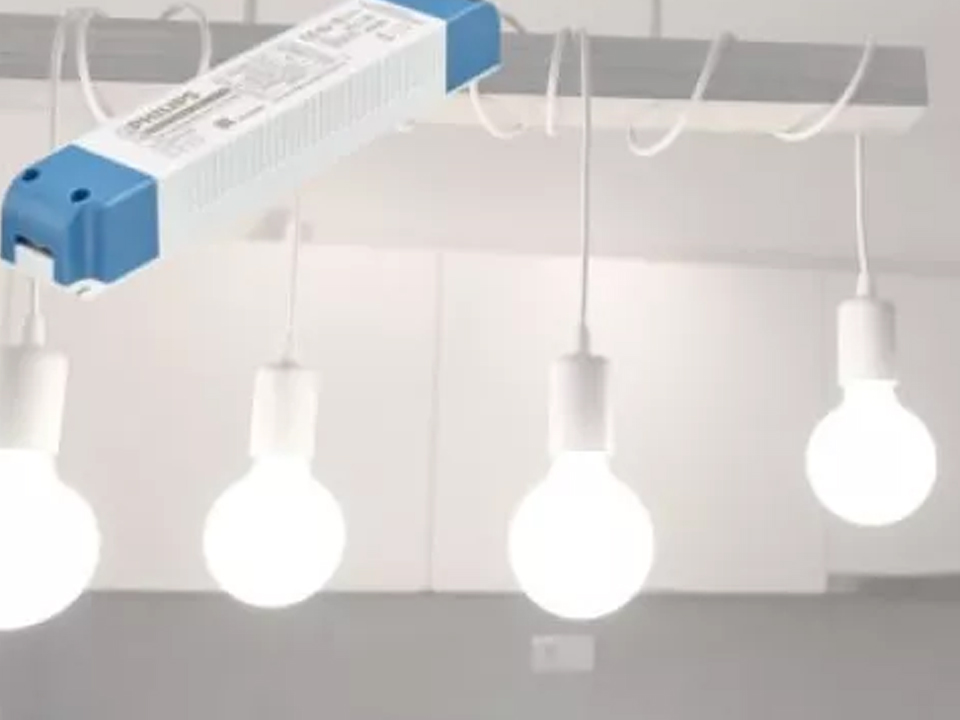
“LED downlight power supply” can describe different systems. Establish which one you have before specifying a shared supply.
A 700 mA LED module does not become compatible with a 24 V supply because their wattages happen to match. MEAN WELL’s LED driver selection guidance explains why the LED operating voltage must fall inside the driver’s specified constant-current operating range. ([MEAN WELL][1])
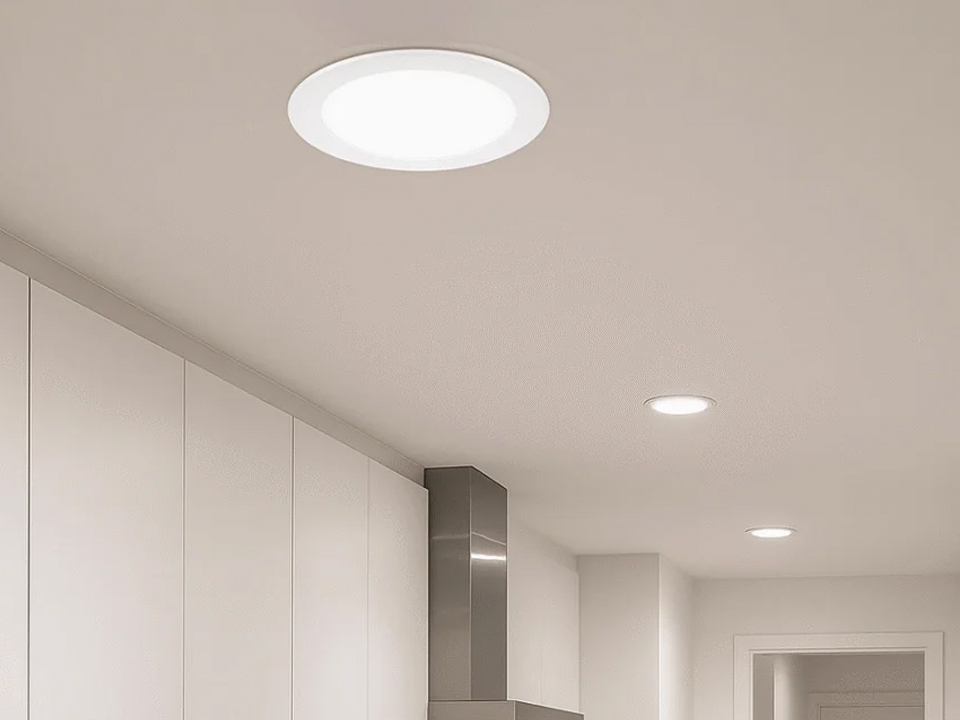
For a product such as this 20W round LED downlight for general ceiling illumination, request the exact driver model, mains input current, output specification, and dimming option. The advertised 20W rating does not establish those details.
Keep manufacturer-matched driver and module combinations intact. Shared constant-current arrangements require explicit approval of the module count and wiring topology; connecting arbitrary driver outputs together is not a capacity upgrade.
For a preliminary single-phase LED lighting circuit load calculation:
Running current = total real input power ÷ (RMS supply voltage × true power factor)
Consider an illustrative installation with 60 luminaires, each consuming 20 W at the mains, operating at 230 V 와 0.90 power factor:
60 × 20 ÷ (230 × 0.90) = 5.80 A
At a power factor of 0.60, the same 1,200 W requires approximately 8.70 A. That is 50% more RMS current for the same real power, which matters when evaluating conductors and equipment ratings.
But check what “20 W” means. If it describes LED output power, driver losses increase mains input power; if it already describes complete-fixture input power, adding those losses again double-counts them.
Use the manufacturer’s input-current data at the project voltage for final sizing. Account for other connected loads, cable installation conditions, protective-device derating, and applicable local loading requirements. A generic “leave 20% spare” rule cannot answer how many LED downlights belong on a particular circuit.
Startup changes everything. Driver capacitors can draw a short charging pulse that bears little resemblance to the steady current on the lighting schedule, especially when a common switch energizes many drivers at once.
Eaton’s published worked example makes the distinction concrete. Its Champ VMVL-7 luminaire draws 0.34 A at 220 V, but its documented startup peak is 49.2 A for 320 microseconds; under the example’s stated B10 breaker assumptions, inrush limits the group to approximately 9 fittings, while its running-current calculation suggests 23. ([Eaton][2])
That example concerns an industrial luminaire, not a universal downlight limit. I use it to show why a wattage-only answer can be badly misleading.
Ask for the exact driver’s inrush peak, pulse duration, and maximum quantity on the proposed breaker. Breaker make, model, curve, supply voltage, and test conditions matter. A peak-current figure by itself does not predict a trip.
Count drivers, too. When specifying a 2×10W square LED ceiling spotlight for retail applications, confirm whether the assembly contains one driver or multiple drivers. Two light heads do not establish the electrical arrangement.
For mains-powered fittings with matched drivers, wiring multiple LED downlights usually means parallel connections on the mains input side. A cable routed from fitting to fitting does not make the LEDs an electrical series string.
I favor grouping by operating area and acceptable outage size: circulation, general illumination, and display lighting often warrant separate consideration. Appropriately protected branches can reduce the area affected by a circuit fault and make maintenance easier.
However, three switched groups connected to one upstream breaker can still create a combined startup event. Splitting a ceiling into software groups does not change its power wiring.
Where the equipment supports it, engineered measures can include smaller independently supplied groups, sequenced mains energization, lower-inrush drivers, or a manufacturer-approved inrush limiter. A programmed fade after every driver receives mains power may leave the initial charging surge unchanged.
Schneider Electric’s installation guidance also identifies transient-current stress on switching contacts. Specify switches, relays, contactors, and sensors using their LED or capacitive-load ratings, including any driver-count limits. ([Electrical Installation Guide][3])
Have a qualified electrician verify the wiring and protection. Increasing breaker amperage or changing its trip curve requires checking conductor protection and fault-disconnection performance; it is not a troubleshooting shortcut.
“Dimmable” is an incomplete purchasing specification. Identify the actual interface: leading-edge phase control, trailing-edge phase control, 0–10 V, or DALI-2, then verify the selected driver and controller combination.
Lutron’s Application Note 487 explains why LED compatibility and loading depend on the control and lamp combination. A dimmer’s incandescent wattage rating does not establish its allowable LED load. Minimum loading, maximum driver count, and the usable dimming range deserve separate checks. ([assets.lutron.com][4])
If your scheme combines an adjustable 25W commercial LED spotlight for retail displays 와 15W deep-recessed LED spotlight for gallery lighting, confirm the driver option for each product and test the proposed combination. Different fixture wattages alone tell us little about whether both will dim smoothly together.
Two documented projects show why controls deserve attention:
Berkeley, California, 2023: The U.S. Department of Energy’s Integrated Lighting Campaign reported annual energy savings of 33%, equivalent to 336,573 kWh, from the Public Safety Building project combining LED replacement lighting with controls and vacancy sensors. That is a project result, not a savings guarantee for a new downlight installation. ([Integrated Lighting Campaign][5])
Franklin, Wisconsin, 2024: DOE recognized Indian Community School for tunable-white LEDs with DALI controls. Its DALI-2 implementation supports individually addressable classroom lighting, shares occupancy information with HVAC through BACnet/IP, and enables diagnostics for equipment including drivers and sensors. ([Integrated Lighting Campaign][6])
My takeaway is practical: evaluate how a large installation will be operated and diagnosed alongside its purchase price. Neither case establishes a maximum fixture count per breaker.
DALI is a control network. Its addressing and communication capabilities do not increase the electrical capacity of a branch circuit. ([Digital Illumination Interface Alliance][7])
Central power supplies can simplify access, but remote low-voltage distribution introduces its own constraints. An illustrative 240 W load at 24 V draws 10 A before allowing for cable losses; long runs therefore need deliberate cable sizing and voltage-drop calculations. Follow the driver’s permitted output-cable lengths and the luminaire’s input limits.
Heat deserves the same scrutiny. Tridonic’s technical guidance ties driver lifetime to operating temperature and installation conditions. Check the permitted ambient temperature, ta, and the driver’s specified case-temperature measurement point, tc; neither a cool room nor an attractive lifetime claim proves the driver is comfortable above a crowded ceiling. ([resources.tridonic.com][8])
Specify access for replacement, observe insulation-contact restrictions, and keep the approved ventilation clearances. A power supply hidden where nobody can service it is a future access problem.
Before handover, have the installer verify the complete proposed group under realistic operating conditions:
A single sample proves very little about the behavior of a fully populated circuit.
The table below uses the earlier illustrative assumptions: 60 complete luminaires, 20 W input each, 230 V, power factor 0.90. These are arithmetic comparisons, not approved circuit capacities or verified specifications for the linked products.
| Arrangement | Calculated running current per branch | Circuit-fault consequence | Remaining design check |
|---|---|---|---|
| One branch of 60 fittings | 5.80 A | A branch trip can extinguish all 60 | Verify startup capacity and switching-device limits |
| Three protected branches of 20 fittings | 1.93 A | An isolated branch trip affects 20; upstream faults can affect more | Verify each branch and simultaneous startup upstream |
| Six protected branches of 10 fittings | 0.97 A | An isolated branch trip affects 10; upstream faults can affect more | Balance added wiring and protection against operational needs |
More branches introduce cost and hardware. I would justify them through protection coordination, switching needs, and the consequences of an outage, rather than choose a fixed number of downlights per circuit by habit.
The allowable number of LED downlights on one circuit is the lowest quantity permitted by the installation’s running-current capacity, driver startup behavior, protective-device coordination, and switching or dimming limits, after accounting for other connected loads, operating conditions, and the requirements applicable to that specific installation.
Request a calculation tied to the actual driver and breaker models. Total watts divided by fixture watts provides only a preliminary estimate.
One LED driver can power multiple downlights only when the manufacturer approves that combination and the connected modules match its output-current or voltage requirements, operating range, wiring topology, cable limits, and total load rating under the intended installation and dimming conditions for the complete system.
Do not assume that separate constant-current modules can share a supply because their combined wattage fits its label.
Preventing LED downlights from tripping a breaker means identifying whether the event comes from sustained overload, driver inrush, a short circuit, or an earth-leakage condition detected by residual-current protection, then correcting that specific cause through verified equipment selection, circuit design, or repair by a qualified electrician.
A trip at switch-on suggests checking inrush, but timing alone is not a diagnosis. Determine which protective function operated before changing components.
The best LED downlight drivers for large groups are models that match the LED modules electrically and provide documented input current, startup characteristics, breaker compatibility, dimming performance, temperature limits, and replacement availability, with evidence that the selected combination operates correctly at the intended group size.
I would reject an unspecified substitute driver until its impact on the circuit and controls has been reviewed.
Send Meagree your fixture quantities, supply voltage, proposed circuit groups, control method, and ceiling conditions when requesting pricing. Ask for the exact driver models, input-current data, inrush specifications, breaker-quantity guidance, dimming compatibility, and installation limits alongside the quotation.
Then have your electrical designer confirm the complete arrangement before procurement. Buy the downlights with the evidence needed to power them reliably.