¿Aún no encuentra la solución de iluminación comercial adecuada? Hable con nuestro equipo de proyectos.
Si ha consultado el sitio web o ya ha hablado de las opciones con el departamento de ventas pero sigue necesitando una orientación más clara, envíe su solicitud aquí. Nuestro equipo revisará su aplicación, las especificaciones de destino y las limitaciones del proyecto, y le responderá con un paso práctico: lo que encaja, lo que necesita confirmación y la ruta más rápida para obtener un presupuesto y archivos listos para las especificaciones de su proyecto.
Revisión directa de su solicitud, especificaciones y limitaciones del proyecto para obtener un presupuesto más claro.
Correspondencia de productos en cuanto a ángulo de haz, CCT / CRI, controladores, regulación y opciones de control.
Apoyo a la documentación del proyecto, incluidas hojas de corte, notas de cableado y archivos IES / LDT cuando estén disponibles.
Orientación OEM / ODM para etiquetas, embalaje, acabado de carcasas y requisitos de marca privada.
Obtenga un presupuesto rápido para Iluminación LED comercial
Diseñado para diseñadores, arquitectos, contratistas, mayoristas y compradores de proyectos. Comparta su aplicación, cantidad y especificaciones de destino para obtener precios directos de fábrica, orientación sobre plazos de entrega y soporte listo para especificaciones para proyectos en EE. UU. y la UE.
Opciones listas para presupuesto: haz / óptica, objetivos CCT / CRI / SDCM, controladores, regulación e integración de controles
Documentación del proyecto: hojas de corte, planos y archivos IES / LDT cuando estén disponibles.
Asistencia OEM / ODM: SKU de marca propia, envases, etiquetas, manuales y etiquetado listo para código de barras
Calidad estable para las implantaciones: SKU repetibles, puntos de control de calidad y suministro escalable para licitaciones y nuevos pedidos.
NDA disponible previa solicitud para planos detallados y archivos del proyecto
Guía completa de compra de iluminación LED comercial para proyectos de venta al por menor, hostelería y oficinas
La mayoría de las guías mienten. Reducen la decisión sobre la iluminación LED comercial a vatios, precio y una bonita representación, aunque la verdadera lucha se centra en el control del haz, el deslumbramiento, la uniformidad del color, la calidad de los controladores, la lógica de los controles, el acceso para el mantenimiento y quién tiene la culpa cuando el espacio tiene mal aspecto después de la finalización práctica. ¿Por qué fingir lo contrario?
He visto este patrón demasiadas veces: un comprador se deja seducir por un bajo precio unitario, el arquitecto asume que la fotometría es “suficientemente cercana”, el contratista cambia el conductor, y seis meses después la boutique parece muerta, los pasillos del hotel parecen baratos, o la oficina se queja de fatiga ocular. No es un problema de iluminación. Es un problema de compras.
Los datos lo avalan. Según el Informe sobre adopción de LED del Departamento de Energía de EE.UU., La adopción de LED ya ahorraba a EE.UU. alrededor de 1.000 millones de euros al año. 1,3 quads de energía y $14.700 millones anualmente en la línea de base del informe de 2018, y el DOE dijo que la mayor alza restante se encontraba en productos comerciales básicos como luminarias lineales y de bahía baja/alta, especialmente cuando se añaden controles. Por separado, Orientaciones de ENERGY STAR sobre iluminación comercial dice que la iluminación sigue representando 17% de electricidad consumida en edificios comerciales de EE.UU.. En pocas palabras, la iluminación sigue siendo lo bastante cara como para importar, y las malas especificaciones siguen siendo lo bastante comunes como para perjudicar.
Índice
La cruda realidad sobre las luminarias LED comerciales
Los lúmenes baratos fallan. Una luminaria puede parecer impresionante en una hoja de especificaciones y, sin embargo, ser inútil en una tienda, miserable en un hotel o agotadora en una oficina porque la óptica es descuidada, el corte es débil, el CCT es incorrecto o el binning es lo suficientemente flojo como para crear una inconsistencia visible en el plano del techo. ¿Por qué tantos compradores siguen pensando en la potencia en lugar del resultado visual?
Para un punto de partida realista, yo no empezaría con un PDF de catálogo aleatorio. Empezaría con un Cartera de iluminación LED comercial y, a continuación, comprobar inmediatamente si el proveedor puede respaldar esa gama con un verdadero control de calidad, documentación y soporte de ingeniería. El sitio web de Meagree centra su oferta en aplicaciones para oficinas, comercios y hostelería, y afirma que el soporte de presupuestos puede incluir óptica, CCT, CRI, objetivos SDCM, regulación, controles y archivos IES/LDT cuando estén disponibles. Esa es la dirección correcta, porque los proyectos reales se ganan o se pierden en esos detalles, no en la imagen del héroe.
Y aquí es donde empiezo a opinar. Si un vendedor no puede hablar limpiamente sobre ángulo del haz, UGR / confort visual, CRI 90 frente a 80, Lógica 3000K / 3500K / 4000K, DALI-2 vs 0-10V, marca del conductor, SDCM, y pruebas de ensayo, Supongo que venden cajas, no soluciones.
Iluminación LED para comercios: el contraste vende, la luz plana mata
El comercio minorista es brutal. No se trata de iluminar una habitación; se trata de dirigir la atención, dar forma a la calidad percibida y ayudar a la mercancía a separarse del fondo sin convertir la tienda en una cámara de deslumbramiento.
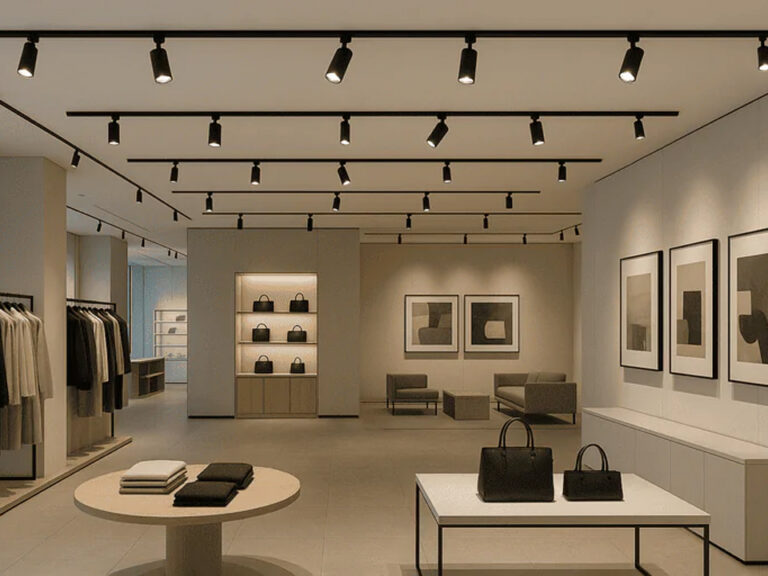
En la iluminación LED minorista, lo primero que me importa son tres cosas: iluminancia vertical, relación acento-ambiente, y disciplina del haz. Un cabezal de riel con la óptica equivocada puede hacer que los productos de primera calidad parezcan ordinarios, mientras que un modesto foco de 12 o 15 W con un control estricto del haz y un alto CRI puede hacer que la pantalla haga el trabajo pesado. Por eso, naturalmente, dirijo a los lectores hacia soluciones de proyectores LED de carril para minoristas cuando se habla de accesorios de iluminación LED comerciales orientados a la exposición. Meagree describe ese foco de carril de 12 W específicamente para interiores de tiendas, salas de exposiciones, galerías, boutiques y hostelería, lo que encaja con la forma en que estos proyectos suelen dividirse en zonas en el mundo real.
La cruda realidad: “la mejor iluminación LED para tiendas” no suele referirse al paquete de lúmenes más elevado. Se trata de ángulos de haz como 15°, 24° y 36, CRI 90+, derrame controlado, y mantener el techo en calma mientras la mercancía se mantiene viva. He visto a minoristas malgastar dinero en producción bruta y luego descubrir que sus estanterías siguen pareciendo planas porque nunca se diseñó la jerarquía de contraste.
Ahí es también donde los controles son menos opcionales de lo que la gente admite. Berkeley Lab's meta-análisis de los controles de iluminación en edificios comerciales encontraron un potencial medio de ahorro de energía en iluminación de 24% para ocupación, 28% para iluminación natural, 31% para sintonización personal, 36% para el ajuste institucional, y 38% para enfoques múltiples. Los compradores minoristas tienden a obsesionarse con el coste de las luminarias e ignoran el dinero más fácil que suponen las escenas, los horarios y la respuesta a la luz diurna. ¿Por qué?
Si quiere pruebas de que un proveedor puede al menos hablar al por menor, el interno estudios de casos de iluminación LED comercial es mejor señal de confianza que un folleto genérico. Meagree names Grupo Parkson y Cadenas de tiendas de marcas kawaii en Jiangsu como referencias minoristas, lo cual es importante porque las cadenas minoristas son en realidad un negocio de repetición disfrazado de negocio de diseño.
Iluminación LED para hostelería: los clientes notan el deslumbramiento antes que el diseño
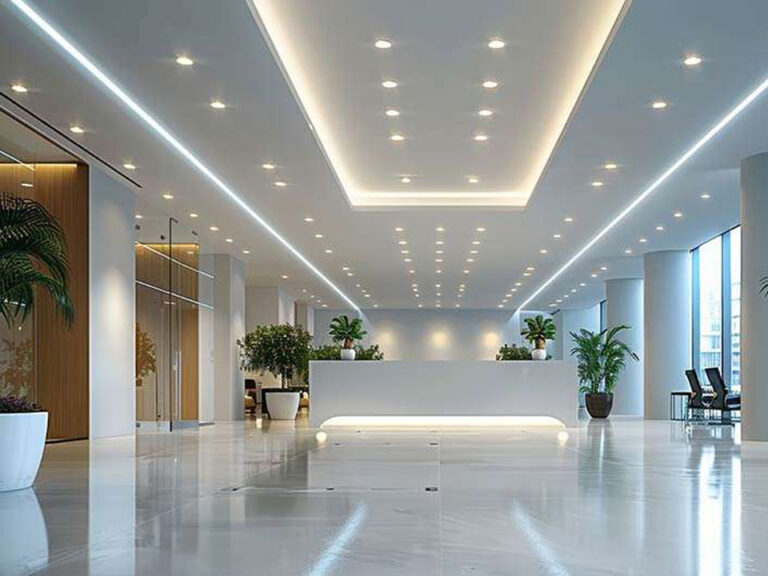
Los huéspedes sienten el resplandor. Puede que no digan “su ángulo de corte es débil”, pero sienten absolutamente la baratura cuando la luz descendente de un pasillo golpea el ojo, cuando el foco de la mesilla de noche centellea con dureza en un cabecero de chapa de madera o cuando el techo del vestíbulo se convierte en una cuadrícula de agujeros brillantes.
Para la iluminación LED de hostelería, empiezo por geometría antideslumbrante, disciplina CCT de cálido a neutro, alta reproducción cromática, y comportamiento de atenuación silenciosa. Por eso, una página como diseños de focos antideslumbrantes para hoteles es más relevante para los compradores que una página genérica de la categoría “iluminación para hoteles”. Meagree describe ese foco empotrable de 8 W como antideslumbrante, enfocado a hoteles y pensado para interiores comerciales refinados, que es exactamente el lenguaje que buscan los especificadores de hostelería antes de pedir pruebas fotométricas más profundas.
Soy escéptico ante cualquier paquete de hostelería que mezcle 2700K, 3000K y 4000K casualmente sólo porque la contratación quiere flexibilidad. Los hoteles no sufren por falta de opciones. Sufren por decisiones incoherentes. En la mayoría de los interiores orientados a los huéspedes, de 2700K a 3000K hacen el trabajo emocional, mientras que las zonas públicas a menudo se asientan alrededor de 3000K con un control más estricto sobre el haz y el apantallamiento. Si añadimos unas curvas de atenuación deficientes o un cambio de color visible, todo el espacio empieza a parecer diseñado con una ingeniería de valor en el peor de los sentidos.
Aquí también importa la cartera interna. Meagree's estudios de casos de iluminación LED comercial cite Shangri-La Hotel Chengdu y Hotel Baiman Shanghai, Y esas referencias son útiles porque los compradores del sector de la hostelería quieren ver si un proveedor ha tocado entornos hoteleros de primera calidad y prácticos, no sólo una foto glamurosa del vestíbulo.
Iluminación LED para oficinas: el confort siempre gana al marketing
Las oficinas perdonan menos de lo que se piensa. Un error en un comercio puede ocultarse a veces con el estado de ánimo. Un error en la oficina está encima de la gente durante ocho horas al día y se manifiesta en forma de quejas, dolores de cabeza, poca comodidad en la pantalla o ajustes interminables tras el traspaso.
Para la iluminación LED de oficinas, mis prioridades son uniformidad, confort visual, lógica de atenuación, y previsibilidad del mantenimiento. Un punto de referencia razonable es opciones de downlights LED para oficinas y vestíbulos, porque Meagree enmarca este downlight comercial de 20 W en torno a interiores limpios y una iluminación fiable para el uso diario en oficinas y vestíbulos. Ese es el marco de compra adecuado: no “¿Cuántos lúmenes?”, sino “¿Seguirá siendo cómodo y útil en un entorno de trabajo real?”.”
Esta es la parte que muchos equipos pasan por alto. En Guía de la GSA sobre iluminación LED y controles para 2024 dice que los estudios de casos del DOE han demostrado Ahorro en calefacción, ventilación y aire acondicionado superior a 20% cuando la misma estrategia de sensores sirve tanto para la iluminación como para la climatización, y también señala que La atenuación del 20% suele ser imperceptible a los ocupantes en escenarios de respuesta a la demanda. Por eso, cuando los compradores de oficinas tratan los controles como complementos decorativos, están dejando sobre la mesa tanto el ahorro operativo como el ajuste del confort. (Administración de Servicios Generales de EE.UU.)
Lo diré claramente: en las oficinas, prefiero comprar una luminaria un poco más cara con un buen control del deslumbramiento, controladores fiables y una secuencia de control que las instalaciones puedan manejar realmente, que una luminaria más barata que obligue a años de quejas y arreglos parcheados.
La matriz de compra que nadie debería saltarse
Las especificaciones importan. Pero el contexto importa más, porque el mismo downlight de 20 W, foco de 12 W o recorrido lineal puede ser sensato en un proyecto y un error en el siguiente.
Tipo de proyecto
Lo más importante
Objetivo típico de CCT
Objetivo CRI típico
Prioridad de control
Yo empezaría con
Principal error de compra
Venta al por menor
Jerarquía de acento, control de haz, luz vertical
3000K-3500K
90+
Escenas, horarios, respuesta a la luz del día
Proyectores de carril, focos, downlights selectivos
Compra de salida alta sin lógica de contraste
Hostelería
Confort antideslumbrante, aspecto cálido, calidad de atenuación
2700K-3000K
90+
Atenuación suave, ajuste de escenas
Focos empotrables, downlights, capas decorativas
Tratar la iluminación del vestíbulo y de las habitaciones como el mismo problema
Oficina
Confort, uniformidad, bajo mantenimiento, controles ROI
Sobrecompra de prestaciones e infracompra de confort visual
Esa tabla no es teoría. Coincide con la posición del DOE de que las categorías comerciales, como las aplicaciones lineales y de alto rendimiento, siguen presentando un gran potencial de ahorro, con la constatación del Berkeley Lab de que los controles mueven regularmente la aguja del ahorro, y con las directrices de control de la GSA que vinculan directamente la estrategia de iluminación a la zonificación, la luz natural, la ocupación e incluso la interacción con la calefacción, ventilación y aire acondicionado.
Cómo elegir iluminación LED comercial sin dejarse engañar
Haga preguntas más difíciles. Un proveedor que merezca su tiempo debe responderlas con claridad, con cifras, dibujos y pruebas, no con adjetivos.
Empezar con documentación, no con promesas
Si un proveedor dice “alta calidad”, quiero saber qué significa eso en la producción. ¿Inspección de entrada? ¿Control de calidad durante el proceso? ¿Envejecimiento? ¿Trazabilidad de los lotes? ¿Flujos de trabajo ISO? Esta es la razón por la que el Proceso de control de calidad de la iluminación LED importa más que una foto de exposición. Meagree afirma que su sistema de control de calidad incluye IQC, IPQC, inspección previa a la expedición, trazabilidad de los lotes, Flujos de trabajo ISO 9001 / ISO 14001, y un Prueba de envejecimiento de 96 horas en todos los LED. Este es el tipo de lenguaje que los equipos de compras pueden utilizar durante la revisión de los proveedores.
Compruebe si la personalización es real o sólo un servicio de logotipo
Se abusa del OEM. Muchas fábricas llaman al reetiquetado básico “OEM/ODM” cuando lo que realmente quieren decir es “podemos imprimir su caja y esperar lo mejor”.”
Por eso busco la profundidad de la ingeniería. En su Servicios de iluminación LED comercial OEM/ODM página, Meagree dice que apoya proyectos con un Equipo de I+D de 10 ingenieros, Creación de prototipos 3D, óptica personalizada, Integración de placas de circuito impreso y controladores, pruebas térmicas y fotométricas, y apoyo a CE, RoHS y FCC caminos. Si eso es cierto en la práctica, se trata de una oferta materialmente diferente a la de una fábrica que sólo intercambia etiquetas y adornos de color.
Adaptar la luminaria a la aplicación, no a la familia de catálogos
Esto parece obvio. Pero no lo es. Los compradores suelen generalizar en exceso, dando por sentado que una misma familia puede realizar por igual la iluminación de un comercio, la iluminación ambiental de una oficina y la acentuación de un establecimiento hostelero. Normalmente no es así.
El propio sitio web de Meagree separa los downlights de oficina/vestíbulo, los proyectores de carril para comercios, los proyectores antideslumbrantes para hostelería, la iluminación lineal, el carril magnético y las categorías más amplias de iluminación LED comercial. Esta separación es saludable. Sugiere que la arquitectura del producto está al menos siendo discutido por aplicación en lugar de empujados en un cubo de SKU catch-all.
Tratar el plazo de entrega como una variable de diseño
Los plazos de entrega cambian las decisiones. Un cambio en el ángulo del haz, un cambio en el protocolo de regulación, una revisión del acabado de la carcasa o la sustitución de un driver pueden convertir un programa ordenado en un caos.
Meagree dice que los modelos regulares y los pedidos repetidos a menudo pueden rondar el 15-20 días después de la aprobación de la muestra, y su flujo de cotización menciona explícitamente el apoyo en torno a la óptica, CCT/CRI/SDCM, controladores, regulación, controles y documentos del proyecto. Esto es alentador, pero yo seguiría obligando al proveedor a confirmar por escrito la disponibilidad de los controladores, la secuencia de las muestras, la aprobación de las muestras doradas y los criterios de envío. La confianza es buena. El papel es mejor.
Preguntas frecuentes
¿Qué es la iluminación LED comercial?
La iluminación LED comercial es una categoría de luminarias y controles basada en especificaciones y diseñada para entornos comerciales con largas horas de funcionamiento, rendimiento fotométrico repetible, diseños sensibles a los códigos y exigencias de mantenimiento, que suelen abarcar oficinas, tiendas minoristas, hoteles, vestíbulos, pasillos, salas de exposiciones e interiores de uso mixto en lugar de un uso residencial ocasional.
En la práctica, eso significa que los compradores deben preocuparse por la óptica, el deslumbramiento, el CRI, el CCT, el protocolo de regulación, la calidad del controlador, los documentos de conformidad y el mantenimiento, no sólo por la potencia y el precio.
¿Cómo elijo la iluminación LED comercial para proyectos minoristas?
La elección de iluminación LED comercial para proyectos minoristas implica seleccionar luminarias y controles que creen contraste, favorezcan la visibilidad de la mercancía, gestionen el deslumbramiento y mantengan estable la reproducción cromática en expositores, pasillos y zonas características, al tiempo que adaptan los ángulos de haz, las alturas de montaje, la lógica de escena y las horas de funcionamiento a la estrategia de comercialización real.
Mi consejo es sencillo: empiece primero por la jerarquía de acento, no por los lúmenes. A continuación, pruebe los ángulos de haz, el CRI 90+ y el control de escenas antes de dar el visto bueno a una implantación. La investigación de Berkeley Lab sobre los controles nos recuerda que la lógica operativa puede ser tan importante como la propia luminaria.
¿Cuál es la mejor iluminación LED para espacios de hostelería?
La mejor iluminación LED para espacios de hostelería es aquella que protege la comodidad de los huéspedes con una óptica de bajo deslumbramiento, un aspecto cromático cálido y uniforme, una regulación fiable y una estratificación específica para cada aplicación en vestíbulos, pasillos, habitaciones, restaurantes y zonas de interés, en lugar de una familia genérica de luminarias distribuida perezosamente por todo el establecimiento.
En otras palabras, los focos empotrados antideslumbrantes, los downlights controlados y la elección disciplinada de los CCT suelen superar a las especificaciones llamativas. Un hotel es un entorno emocional, y un mal deslumbramiento pone de manifiesto la tacañería más rápidamente que cualquier otra cosa.
¿Merece la pena pagar por los controles de iluminación en los proyectos de oficinas?
Merece la pena pagar por los controles de iluminación en los proyectos de oficinas cuando mejoran la zonificación, la respuesta de la ocupación, el uso de la luz natural, la visión del mantenimiento y la interacción del sistema, especialmente en oficinas abiertas, zonas compartidas y espacios con patrones de uso variables en los que la conmutación manual y la iluminación de salida fija desperdician energía y tolerancia de los ocupantes.
Las pruebas son más sólidas de lo que muchos compradores admiten. El Berkeley Lab descubrió ahorros medios que oscilan entre 24% y 38% en función de la estrategia de control, y las directrices de la GSA para 2024 afirman que los estudios de casos del DOE mostraron ahorros en calefacción, ventilación y aire acondicionado superiores a 20% cuando la detección de ocupación es compatible con ambos sistemas.
¿Qué debe incluir un proveedor de iluminación LED comercial en un paquete de presentación serio?
Un paquete serio de presentación de iluminación LED comercial debe incluir hojas de corte, archivos fotométricos como IES o LDT cuando estén disponibles, información sobre controladores y regulación, documentación de conformidad y pruebas, detalles de acabados y materiales, notas de lógica de control, criterios de aprobación de muestras y pruebas de calidad a nivel de lote que los equipos de adquisición y obra puedan verificar antes del envío.
También pediría el lenguaje de binning, los términos de la garantía, la política de sustitución de controladores y la prueba de inspección previa al envío. Meagree dice explícitamente que puede admitir hojas de corte, notas de cableado, archivos IES/LDT y discusiones de especificaciones listas para presupuesto sobre óptica, CCT/CRI/SDCM, controladores, atenuación y controles.