¿Aún no encuentra la solución de iluminación comercial adecuada? Hable con nuestro equipo de proyectos.
Si ha consultado el sitio web o ya ha hablado de las opciones con el departamento de ventas pero sigue necesitando una orientación más clara, envíe su solicitud aquí. Nuestro equipo revisará su aplicación, las especificaciones de destino y las limitaciones del proyecto, y le responderá con un paso práctico: lo que encaja, lo que necesita confirmación y la ruta más rápida para obtener un presupuesto y archivos listos para las especificaciones de su proyecto.
Revisión directa de su solicitud, especificaciones y limitaciones del proyecto para obtener un presupuesto más claro.
Correspondencia de productos en cuanto a ángulo de haz, CCT / CRI, controladores, regulación y opciones de control.
Apoyo a la documentación del proyecto, incluidas hojas de corte, notas de cableado y archivos IES / LDT cuando estén disponibles.
Orientación OEM / ODM para etiquetas, embalaje, acabado de carcasas y requisitos de marca privada.
Obtenga un presupuesto rápido para Iluminación LED comercial
Diseñado para diseñadores, arquitectos, contratistas, mayoristas y compradores de proyectos. Comparta su aplicación, cantidad y especificaciones de destino para obtener precios directos de fábrica, orientación sobre plazos de entrega y soporte listo para especificaciones para proyectos en EE. UU. y la UE.
Opciones listas para presupuesto: haz / óptica, objetivos CCT / CRI / SDCM, controladores, regulación e integración de controles
Documentación del proyecto: hojas de corte, planos y archivos IES / LDT cuando estén disponibles.
Asistencia OEM / ODM: SKU de marca propia, envases, etiquetas, manuales y etiquetado listo para código de barras
Calidad estable para las implantaciones: SKU repetibles, puntos de control de calidad y suministro escalable para licitaciones y nuevos pedidos.
NDA disponible previa solicitud para planos detallados y archivos del proyecto
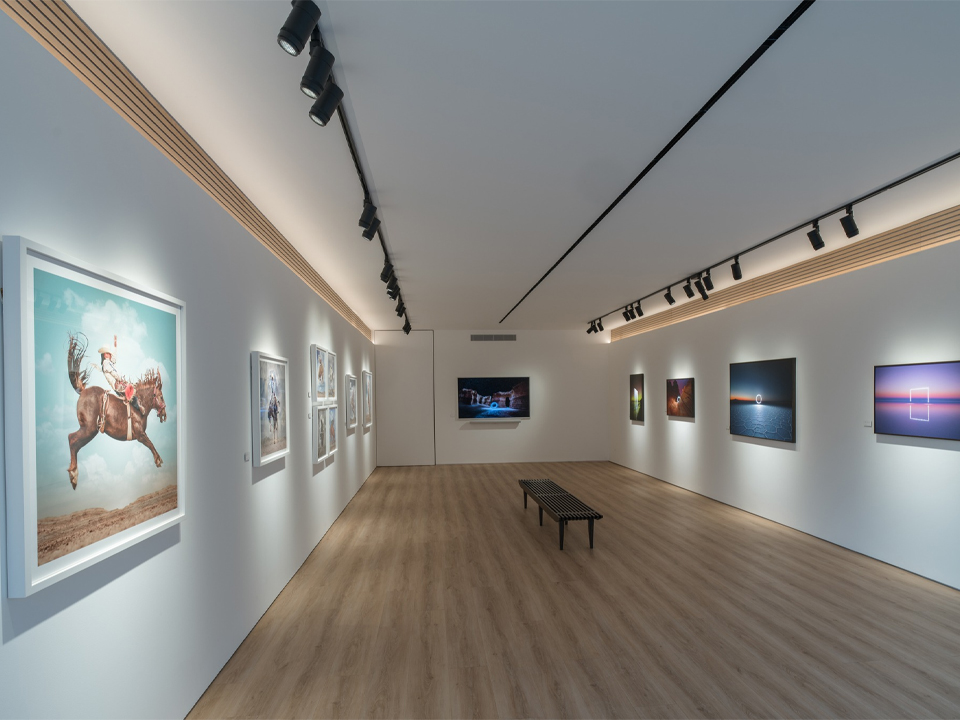
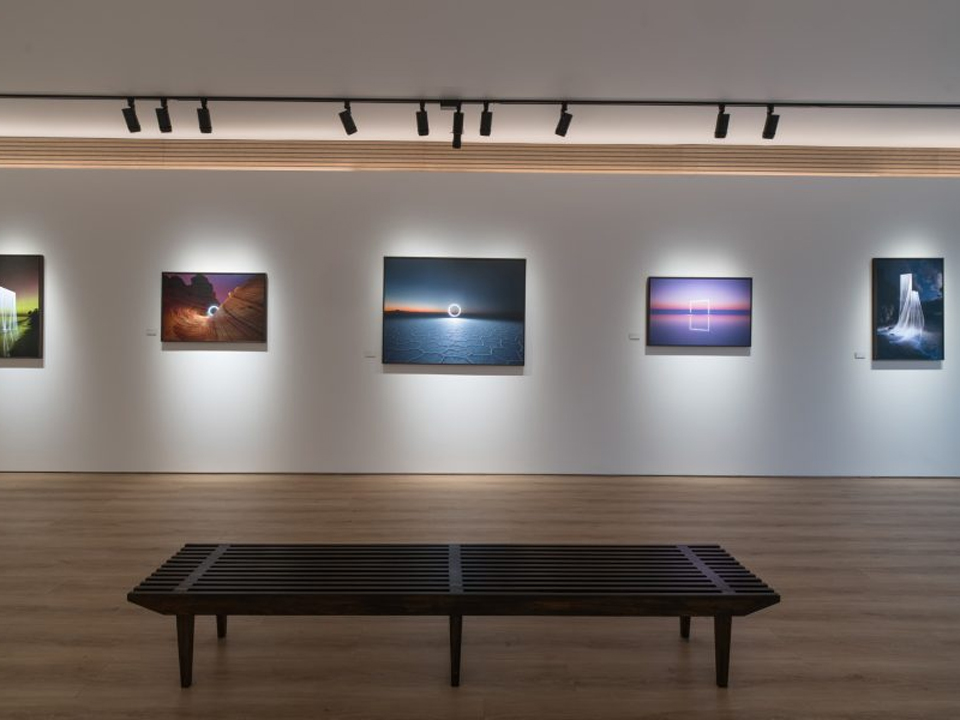
Art Wall Lighting with Track Systems and Better Uniformity Control
Brightness proves little. When I assess an art lighting proposal, I want to know whether its optics, mounting geometry, and controls can illuminate the entire display area consistently while respecting the artwork’s exposure limits and the visitor’s actual viewing position. What does a beautifully illuminated ceiling prove about the painting underneath it?
Very little.
My starting point is simple: specify the light that reaches the artwork. Then select the equipment capable of delivering it.
Track systems make that process flexible. But flexibility only becomes useful when the fixtures have appropriate light distributions, the track sits in the right place, and someone measures the finished installation.
Art Lighting Uniformity Starts with a Defined Measurement Area
“Even illumination” is an incomplete specification.
Even across one painting? Across a row of framed photographs? Across the entire wall, including the space above the hanging line?
I would settle that question before discussing fixture quantities. Otherwise, a supplier can calculate an impressive average over an area that does not represent the actual display.
For a defined measurement grid, two useful metrics are:
Minimum-to-average uniformity: U₀ = E_min ÷ E_avg. Values closer to 1 indicate more consistent illuminance.
Maximum-to-minimum ratio: E_max ÷ E_min. Lower values indicate less variation between the brightest and darkest measured points.
Use both. An acceptable minimum-to-average result can still conceal an excessive peak.
For an initial project brief, I might propose U₀ ≥ 0.70 and E_max/E_min ≤ 2:1, subject to a full-size mock-up and agreement with the collection team. These are example acceptance criteria, not universal museum standards.
The artwork’s maximum permitted illuminance remains a separate requirement. A uniformly overlit watercolor is still overlit.
And illuminance uniformity does not guarantee identical perceived brightness: dark pigments, pale paper, textured paint, and reflective glazing interact differently with the same incident light.
Choose Track Lighting for Artwork by Optical Function
The track supplies power and supports positioning. The fixture’s optics determine the distribution.
Para uniform wall illumination, I would start by evaluating dedicated wallwasher optics. For individual objects that need visual emphasis, I would evaluate spot or flood distributions. ERCO’s gallery guidance makes this functional distinction: wallwashing connects an exhibition visually, while directional lighting emphasizes individual works.
That distinction matters when reviewing products.
En 15W adjustable magnetic track spotlight for display illumination is presented as an adjustable fixture for modular display layouts. Its positioning flexibility makes it a candidate for an accent-lighting mock-up; the published description alone does not establish full-wall uniformity.
The same scrutiny applies to the 10W narrow-beam linear LED spotlight for accent lighting. “Linear” describes its form; the product is explicitly presented as a narrow-beam accent fixture. Housing shape does not establish a wallwashing distribution.
Before approving a track system, I would request:
IES or LDT photometric files matching the selected optic and output.
Confirmed compatibility between track, adapters, power supply, and controls.
Measured color-rendering data.
Demonstrated dimming performance at the intended display level.
A practical method for replacing drivers, optics, and fixtures.
A product photograph cannot answer those questions.
Track Lighting Spacing for Artwork Requires Geometry and Photometry
There are two separate dimensions to resolve: the track’s distance from the wall and the spacing between fixtures along the track.
Confusing them is expensive.
ERCO recommends approximately one-third of room height as a starting wall offset for relevant track arrangements. In a 3 m room, that produces an initial offset of about 1 m. Its guidance also identifies specialized wallwashers that work at shorter offsets, demonstrating why a rule of thumb must remain tied to the selected optics.
For accent lighting, ERCO’s planning guidance uses the familiar 30° museum angle. That addresses aiming geometry; it does not establish spacing for a continuous wallwash.
Consider a worked example. If the vertical difference between a spotlight and the artwork’s center is 1.8 m, aiming at 30° from vertical gives:
Horizontal offset = 1.8 × tan(30°) ≈ 1.04 m.
That calculation positions the beam axis. It tells us nothing by itself about corner illuminance, frame shadows, or reflections.
My commissioning sequence would be:
Define the artwork area and measurement grid.
Model the actual fixtures at the proposed mounting height and offset.
Adjust fixture spacing, including the first and last positions.
Build a representative wall section with frames and glazing.
Measure it at the intended dimming level.
Inspect reflections from standing and seated viewing positions.
I would also test a plausible future hanging arrangement. A flexible gallery should remain usable after the first exhibition comes down.
Control Glare, Color Rendering, and Exposure Together
“High CRI” is a starting point.
The Canadian Conservation Institute’s Technical Bulletin 36 recommends CRI ≥ 90 and R9 ≥ 50 for good-quality museum lighting, increasing R9 to ≥ 90 for its excellent-quality category. R9 addresses saturated red rendering, which the usual CRI average does not adequately describe.
I would request both numbers in the submittal.
Color temperature deserves a mock-up too. CCI identifies 3000 K as a practical general choice, while explaining that color-temperature preference varies and should not be confused with light quality.
Glare requires an equally concrete review. Walk the room. Sit down. Approach a glazed print from either side. A fixture can look comfortable from the doorway and appear as a bright reflection directly over the artwork from another position.
For the surrounding hospitality space, the 25W deep anti-glare ceiling downlight is presented as a recessed ambient-lighting option. I would assess it separately from the artwork lighting, then test both together for reflections and visual adaptation.
Exposure adds another dimension. CCI emphasizes that LED lighting does not remove the relationship between light damage, illuminance, and exposure time.
For illustration, 50 lux × 6 hours per day × 50 days = 15,000 lux-hours. That is an exposure calculation, not a declaration that a particular object can tolerate it.
We need the collection’s limits before we program the scenes.
I would separate wallwashing, accents, and circulation lighting into suitable control groups, then test individual adjustment where the display requires it. Dimming an entire row cannot correct an unsuitable beam distribution within each fixture.
What Three Museum Projects from 2023–2024 Actually Demonstrate
The evidence supports careful integration of optics, controls, and conservation requirements. It does not support a universal fixture recipe.
National Gallery of Australia, 2023–24. Its annual report describes a Bluetooth LED gallery lighting system that improved visual quality, reduced spill over artworks, and improved energy efficiency. The report also records recycling 9,015 kg of aluminum during the project. Those are institutional project disclosures; they do not provide a transferable wall-uniformity ratio.
My takeaway: assess the complete installation, including light spill, operation, and replacement infrastructure.
National Gallery Singapore, 2022/2023 reporting period. Its sustainability report records LED lighting with digital monitoring in galleries and circulation areas, alongside building-management optimization. It also identifies a 30% energy-use-intensity reduction ambition, which is a building objective—not a measured saving attributable solely to lighting.
That distinction belongs in every serious payback discussion. A whole-building target cannot substantiate a luminaire performance claim.
National Portrait Gallery, London, June 2023. Lighting designer Studio ZNA describes a redisplay of more than 1,000 artworks, combining oil paintings with sensitive photography and works on paper. Its project account explains the use of prototypes and Bluetooth control in temporary exhibition galleries. This is the designer’s account, rather than an independent performance audit.
What interests me is the commissioning effort. Different objects demanded different treatments, even within a shared visitor experience.
Compare Uniformity Data Before Comparing Fixture Prices
Here is why I distrust an average-lux figure presented alone.
The following illustrative calculation uses two invented nine-point measurement grids. Read each grid row by row across the same display area; these are not measurements from the museum projects above.
Measurement
Layout A: pronounced center hotspot
Layout B: more even distribution
Top row, lux
60, 100, 60
90, 100, 90
Middle row, lux
100, 260, 100
100, 140, 100
Bottom row, lux
60, 100, 60
90, 100, 90
Average illuminance
100 lux
100 lux
Minimum illuminance
60 lux
90 lux
Maximum illuminance
260 lux
140 lux
U₀: minimum ÷ average
0.60
0.90
Maximum ÷ minimum
4.33:1
1.56:1
Meets the example uniformity criteria above?
No
Sí
Same average. Substantially different distribution.
Layout B passes the proposed uniformity checks, but both layouts would exceed an artwork limit of 50 lux. Uniformity approval and conservation approval must therefore remain separate.
A nine-point grid also offers limited resolution. For a real acceptance test, I would use a sufficiently dense grid to capture beam overlaps, edges, and localized peaks, with its dimensions agreed before commissioning.
The purchasing question becomes more useful: What installed system meets the agreed measurements, and what does it cost to maintain that result?
FAQs About Art Lighting and Track Systems
What is wall washer track lighting?
Wall washer track lighting is a track-mounted lighting arrangement that uses fixtures with distributions designed to illuminate a vertical surface evenly, with the final result depending on mounting height, wall offset, fixture spacing, aiming, and the area over which uniformity is measured.
I would verify the exact optic through its photometric file and a representative mock-up.
How do I light wall art evenly?
Lighting wall art evenly is the process of selecting suitable optics, positioning fixtures to create controlled overlap, and adjusting their output until measurements across the display area meet an agreed uniformity target while remaining within the artwork’s maximum illuminance and exposure limits.
Check the corners and edges as carefully as the center. Then inspect the actual viewing experience.
What is the best track lighting for art?
The best track lighting for art is a compatible system of track, fixtures, optics, and controls that meets the specific collection’s requirements for color rendering, glare management, illumination distribution, exposure, and future display changes, with performance demonstrated through documentation and a realistic mock-up.
I would choose from the verified results rather than rank products by wattage.
What determines track lighting spacing for artwork?
Track lighting spacing for artwork is the distance between fixtures required to achieve the intended distribution across a defined display area, determined by the selected photometry, mounting height, wall offset, aiming, artwork dimensions, and acceptable variation between the brightest and darkest measured points.
Keep fixture spacing separate from track-to-wall offset in drawings and quotations.
Specify Your Art Wall Before Ordering the Track
Send Meagree Light your wall dimensions, mounting height, artwork sizes, glazing details, target illuminance, and control requirements. Request a proposed layout, matching photometric files where available, confirmed color data, and samples for a representative wall test.
For adjustable accents, use the 15W magnetic track spotlight product inquiry to begin that technical discussion. For continuous wallwashing, explicitly request a suitable wallwasher optic and evidence of its coverage.
I would approve the order only after the proposed equipment demonstrates the agreed result on the wall.