Still Not Seeing the Right Commercial Lighting Solution? Talk to Our Project Team.
If you have reviewed the website or already discussed options with sales but still need a clearer direction, send your request here. Our team will review your application, target specifications, and project constraints, then reply with a practical next step: what fits, what needs confirmation, and the fastest route to a quote and spec-ready files for your project.
Direct review of your application, specs, and project constraints for a clearer quote path.
Product matching across beam angle, CCT / CRI, drivers, dimming, and controls options.
Project documentation support, including cut sheets, wiring notes, and IES / LDT files where available.
OEM / ODM guidance for labels, packaging, housing finish, and private-brand requirements.
Get a Fast Quote for Commercial LED Lighting
Built for designers, architects, contractors, wholesalers, and project buyers. Share your application, quantity, and target specifications to get factory-direct pricing, lead-time guidance, and spec-ready support for US and EU projects.
When to Use Haze Reflectors in Recessed Lighting Applications
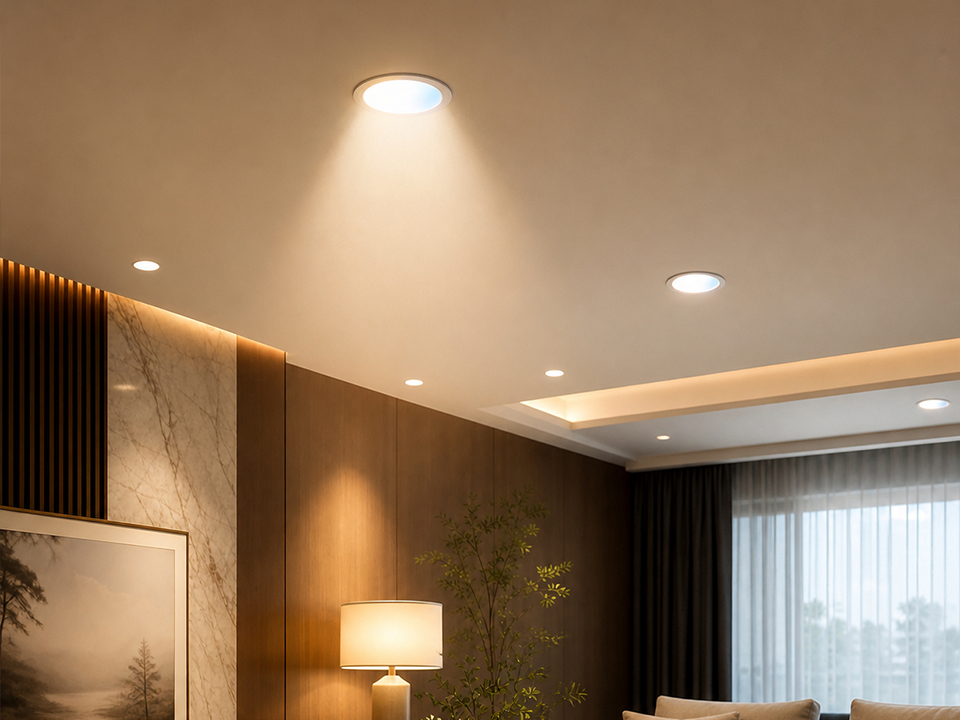
When loads– or hundreds– of recessed downlights are mounted, an extremely bright aperture comes to be more than a visual inconvenience: it ends up being an irreversible visual-comfort issue that lowering alone might not resolve without lowering the lighting the job really needs.
So why is the reflector coating still dealt with like a cosmetic alternative?
A haze reflector is generally defined when a designer desires the effectiveness and light beam control of a metal recessed lighting reflector trim, however does not desire the sharp illumination, mirrored light image, or “ceiling filled with fronts lights” impact associated with a very sleek reflector.
That is the useful response. Yet it is not the whole response.
My candid sight is that haze trim is frequently advised too casually. It can improve regarded comfort, especially throughout lengthy sightlines and in lower ceilings, yet it can not rescue a shallow component, an exposed LED emitter, an extreme lumen bundle, or a severely chosen light beam angle.
The geometry still wins.
The Brief Solution: When to Utilize Haze Reflectors
Use a haze reflector recessed illumination arrangement when occupants will frequently see the downlight apertures from throughout the area and you require a quieter look without compromising as much output as a dark baffle or black cone might absorb.
Typical applications consist of:
Living areas, eating spaces, resort lounges, and reception areas with reduced or moderate ceiling elevations
Open-plan interiors where people see long rows of recessed fixtures
Retail circulation zones requiring valuable ambient light without mirror-bright apertures
Offices, meeting rooms, and friendliness areas with glossy tables or displays
White ceilings where a black reflector would develop an unwanted dark-hole result
General downlighting where a sleek clear reflector looks also intense
For broad business illumination, a 20W round LED downlight for general ceiling lighting is the sort of component where reflector appearance, protecting deepness, lumen outcome, and spacing has to be examined together. A haze surface may enhance aesthetic acceptance, however only the item’s photometric data can show what happens to beam distribution and high-angle strength.
Do not define haze just because words “anti-glare” shows up next to it. That label is commonly abused.
What a Haze Reflector Really Does
A haze reflector is usually an anodized aluminum or metal cone with a gently textured, semi-specular surface area. It stays reflective, however it creates an obscured reflection instead of the crisp mirror image developed by a clear or sleek reflector.
That difference issues.
A refined reflector may maximize optical effectiveness and create specific beam of light control, yet its surface can duplicate a brilliant picture of the lamp, COB, lens, or LED component. From certain watching settings, the reflector itself appears to illuminate.
A haze surface spreads that mirrored photo over a wider area. The peak brightness of the representation might therefore show up softer, also when the overall lumen result stays relatively high.
Cooper Lighting’s HALO recessed-lighting directory describes haze reflectors as reducing glow while keeping high efficiency. That is a reasonable recap, however it should not be taken a global performance guarantee: reflector depth, aperture dimension, LED position, beam of light angle, and surface area treatment still vary between item family members.
A haze reflector is not the same as:
A black baffle, which utilizes dark ribs or surfaces to take in roaming light
A white reflector, which generates wide scattered representation and aesthetically merges with a white ceiling
A lens or diffuser, which sits in the optical course and spreads out transmitted light
A deep cone, which conceals the resource with physical protecting
A wall-wash trim, which intentionally reroutes light toward a vertical surface area
These gadgets solve various troubles. Treating them as compatible is exactly how otherwise commendable requirements fail.
How Do Haze Reflectors Reduce Glow?
Haze reflectors reduce one certain part of glow: the intense, mirror-like representation of the light inside a metal downlight cone.
They might likewise make the transition between the bright aperture and the bordering ceiling really feel less sudden. This is particularly noticeable when components are seen obliquely from sofas, dining chairs, workdesks, passages, or retail aisles.
Yet there are three different glare devices to think about:
Direct resource glare: The LED, lens, or luminous surface is literally visible.
Shown resource glow: The source appears as a brilliant image in the reflector.
Contrast glare: The aperture is significantly brighter than the ceiling and bordering field of vision.
A haze reflector mostly deals with the second device. It might aid with the 3rd. It does not reliably get rid of the first.
That is the difficult reality.
When the LED remains noticeable at regular watching angles, much deeper recessing, a smaller aperture, a honeycomb louver, a better cutoff angle, or a lower-output optic normally matters greater than the surface. A 15W deep-recessed LED spotlight for gallery and gallery lights shows the stronger geometric approach: move the emitting surface area further over the ceiling airplane so the real estate literally guards it from typical sightlines.
The U.S. Department of Power made a wider yet relevant point in its November 2024 LED-upgrade assistance: LED distributions can enhance the opportunity of fixture glow compared with fluorescent systems, and real-space testing is recommended prior to a building-wide installation. The very same reasoning relates to recessed downlights. A making or directory picture is not a glare examination.
Haze vs White Reflector vs Black Baffle
The haze vs white reflector dispute is regularly decreased to color choice. That is lazy requirements.
The surface changes how the aperture acts visually, how shown light is dispersed, and exactly how plainly the fixture appears when it is switched on or off.
Trim or optic
Aperture look
Glow control
Outcome propensity
Ideal use
Haze reflector
Soft silver or satin gray
Modest reflected-glare reduction
Normally high
Comfortable ambient lighting with useful performance
Clear specular reflector
Bright, mirror-like metal surface
Reduced to modest
Often greatest
High ceilings, maximum result, firmly crafted circulations
White reflector
Blends with a white ceiling when off
Modest, product-dependent
Moderate to high
Residential and commercial ceilings where aesthetic assimilation issues
Retail, hospitality, magnetic systems, focused accent light
A white reflector is typically less aesthetically assertive when the luminaire is off. Once brightened, nevertheless, it might come to be a broad intense surface. A haze reflector usually looks somewhat darker than white but much less severe than black, making it a useful compromise for white ceilings.
A black baffle can offer stronger suppression of stray reflections, however it may create a populated pattern of dark apertures. In minimalist interiors, this may be willful. In standard household spaces, it can look commercial.
And a clear reflector? It is not immediately bad. In a 5 m ceiling where passengers hardly ever see deeply right into the component, optimizing useful light may be more practical than investing effectiveness to soften an aperture that is barely noticeable.
Where Haze Reflector Trim Executes Best
Reduced and Medium Ceilings
Haze trim is most useful where sightlines are shallow. In an eight-foot or 2.4 m property ceiling, a seated passenger can quickly see right into fixtures numerous metres away.
This is where refined reflectors tend to betray themselves.
For these spaces, I would initially check resource regression and aperture luminance, then contrast haze, white, and black samples at real placing elevation. A trim sample held under display room illumination informs you practically absolutely nothing.
Open-Plan Residential Interiors
Open kitchen areas, dining areas, and living spaces frequently include 12, 18, or even 25 recessed downlights within one continual visual area. A solitary sleek reflector might be tolerable. A grid of twenty can resemble a flight terminal technique course.
Haze reflectors can minimize that duplicated glimmer while retaining a cleaner, lighter ceiling look than black cones.
However fewer fixtures with better circulation might be the much better solution. The sector rarely says this because selling eighteen downlights is less complicated than upgrading the layout around twelve.
Hospitality and Reception Locations
Hotels, bars, lounges, and reception areas require regulated brightness because residents spend extended periods seated and frequently look across the space as opposed to right down.
Haze reflectors can support flow illumination, but they are not instantly the very best reflector trim for recessed lights over paintings, fashion jewelry, mannequins, or goods.
For costs retail, I would usually divide the system into:
Quiet ambient illumination
Flexible accent lights
Vertical lighting for walls and goods
Ornamental or top quality illumination
Attempting to make one recessed downlight perform all four roles produces mediocre results.
Big Retail Ceiling Grids
Big retail areas frequently suffer from fixture rep instead of glow from one private light. Hundreds of tiny bright apertures can produce visual mess even when each luminaire passes its technical specification.
Because instance, less continual components may be cleaner than another reflector surface. A 24W modular direct LED fixture for retail screen ceilings can form component of the ambient layer while flexible limelights manage goods.
This is not a debate against haze reflectors. It is a disagreement against addressing a format issue with a surface code.
When Not to Make Use Of a Haze Reflector
A haze reflector is normally the wrong front runner in the adhering to circumstances.
When the Resource Is Currently Deeply Shielded
If the LED component sits much above the ceiling aircraft and can not be seen from typical positions, altering from clear to haze might create only a minor aesthetic distinction.
The much deeper geometry has currently done the heavy work.
When Optimum Optical Performance Is the Key Goal
A controlled specular reflector might supply more useful lumens or tighter distribution. Haze treatments scatter reflections, and any kind of spreading can change the beam or lower peak intensity.
The specific difference is product-specific. Ask for data.
DOE’s April 2024 general-service-lamp guideline records NEMA’s observation that frosted lamps decrease glow while being a little less efficient. A frozen lamp and a haze reflector are not the same optical part, however the underlying trade-off recognizes: softening a bright optical photo might cost some performance or intensity.
When Accurate Accent Illumination Is Required
A slim 10 °, 15 °, or 24 ° beam used for artwork, luxury goods, or building details requires meticulously managed optics. A haze surface area might soften the beam edge or minimize peak candela, relying on the design.
Utilize the reflector and lens combination tested by the producer. Do not assemble a trim, lamp, and housing from three unassociated item households and expect the published photometry to stay valid.
In Wet or Contaminated Locations
Showers, food-preparation areas, research laboratories, messy workshops, and some medical care environments may need a gasketed lens, cleanable surface, or particular ingress-protection score.
A decorative open haze reflector does not provide that security.
When the Actual Trouble Is Extreme Lumen Result
A 1,500-lumen downlight does not end up being comfortable merely because its reflector is satin-finished.
Reduce outcome. Increase component spacing. Usage dimming. Improve resource regression. Adjustment the light beam. Or redesign the lights layers.
Occasionally the trim is innocent.
The Photometric Data I Would Demand Before Approval
Do not approve haze reflector trim from a finish chip alone. At minimum, demand an IES or LDT apply for the specific LED module, power level, beam of light angle, reflector, and trim mix.
I would evaluate:
Information factor
What it discloses
Indication
Supplied lumens
Actual output after optic and trim losses
Only raw LED lumens are provided
Beam of light angle
Size of the main beam
One beam of light angle claimed for every single trim
Area angle
Width of lower-intensity spill light
Missing from accent-light requirements
Optimum candela
Beam of light intensity
Very high strength in a reduced ceiling
Zonal lumen distribution
Where light leaves the component
Extreme high-angle output
Cutoff or shielding geometry
Whether the source shows up
Superficial module close to ceiling airplane
Spacing requirement
Approximate harmony possibility
Fixtures laid out by uncertainty
CCT
Evident warmth: usually 2700 K, 3000 K, or 4000 K
Mixed CCTs across one ceiling
CRI and R-values
Colour rendering top quality
“High CRI” without a stated number
SDCM
Colour uniformity between fixtures
No tolerance specified for huge orders
Dimming range
Low-end control
“Dimmable” without any examined motorist checklist
Flicker data
Temporal light habits
No test method or percentage stated
The DOE’s 2024 policy includes a depictive directional LED example of an 8 W GU5.3 MR16 producing 500 lumens, with 62.5 lm/W efficiency, a 25,000-hour ranked life, 2700 K CCT, and CRI 80. That degree of specificity is what specialist buyers ought to expect– not a pamphlet stating “soft light, high illumination.”
The same regulation referrals UL 1598C-2016 in its definition of an LED downlight retrofit kit. Qualification issues for item safety and retrofit suitability, however UL category does not tell you whether an aperture will really feel comfy from a couch or seminar table. Safety compliance and aesthetic high quality are separate checks.
DOE’s November 2024 assistance estimated prospective energy financial savings of 40%– 60% for LED retrofit sets and new LED luminaires compared with a fluorescent baseline. That is engaging, however an energy-saving job can still produce worse glare if the new circulation is not checked. Effectiveness does not excuse negative optics.
Common Haze Reflector Spec Mistakes
Specifying “Haze” Without a Finish Typical
One maker’s haze may be a light satin silver. An additional might look darker, warmer, or virtually specular.
Call for a physical sample and created surface code.
Overlooking the Off-State Look
Clients live with components while they are off, too. A haze cone might stay visibly grey against a white ceiling, whereas a white trim essentially disappears.
Provide both states.
Contrasting Fixtures at Different Outputs
A 700-lumen haze downlight will naturally show up much less hostile than a 1,400-lumen clear reflector. That does not confirm the finish created the enhancement.
Contrast equal power level, equivalent lumen output, equivalent beam of light angle, and equal dimming level.
Believing UGR Addresses Every Little Thing
Unified Glow Ranking can be useful for normal interior illumination plans, however several decorative or accent downlights are not presented with a solitary significant UGR value for every single feasible space geometry.
The luminaire, spacing, seeing instructions, area dimensions, surface reflectances, and observer placement all affect the outcome.
Avoiding the Mock-Up
A four-fixture ceiling mock-up can reveal what a spreadsheet will not: reflected photos in a television, shimmer across a sleek stone counter, discomfort from a seated position, and the aesthetic rhythm of duplicated apertures.
Develop it early.
Yes, it costs cash. Changing 200 trims costs more.
Frequently Asked Questions
What is a haze reflector in recessed lighting?
A haze reflector is a recessed-light trim with a softly textured, normally plated metal inside that redirects valuable light while muting the sharp mirror image and high obvious brightness generated by a refined reflector, giving the aperture a quieter appearance without taking in as much light as a black baffle.
It is generally selected for property, friendliness, workplace, and retail interiors where residents can see numerous downlight apertures throughout the ceiling.
How do haze reflectors minimize glare?
Haze reflectors reduce glow by scattering the sharp reflection of an LED source, light, or optical lens across a softly textured metal surface area, reducing the viewed intensity of the mirror picture while preserving much of the reflector’s capability to reroute light into the intended descending beam of light.
They do not necessarily conceal a directly visible LED. Deep recessing, securing angles, louvers, and reduced lumen output might still be needed.
Is a haze reflector better than a white reflector?
A haze reflector is better when the concern is softening shown resource brightness while retaining a metallic reflector’s controlled distribution, whereas a white reflector is better when the priority is mixing the dark fixture right into a white ceiling and creating a much more extensively diffused aesthetic appearance.
Neither choice is widely premium. Compare physical samples, delivered lumens, high-angle strength, and off-state look.
What is the very best reflector trim for recessed lights in low ceilings?
The very best reflector trim for low ceilings is generally a deep, well-shielded optic with regulated result, selected after inspecting typical seated sightlines; a haze reflector can enhance reflected glare, while a black cone or grille might provide more powerful testing when residents can still see the source straight.
For ceilings around 2.4– 2.7 m, regression deepness often matters greater than reflector color.
Can I change a white recessed trim with a haze reflector cut?
A white trim can be changed with a haze reflector just when the brand-new trim is noted or accepted for the precise real estate, LED component, aperture dimension, thermal configuration, and electrical system, due to the fact that an incompatible reflector can change light beam circulation, retention, heat administration, security category, and service warranty insurance coverage.
Do not choose a replacement by small diameter alone. Confirm the housing series and maker compatibility table.
Are haze reflectors suitable for kitchens?
Haze reflectors appropriate for kitchen areas when they give comfortable basic illumination over flow and seating locations, however task areas over counters might require greater upright or straight illumination, bigger circulations, or extra under-cabinet lights as opposed to simply increasing the output of every recessed downlight.
Watch for reflections in polished stone, stainless steel, glass, and glossy cupboard surfaces. A sample installation deserves the initiative.
Define the Optic, Not Simply the Electrical power
The most effective haze reflector recessed illumination specification ought to mention more than “15 W, 3000 K, haze trim.”
It must determine the specific real estate, LED component, reflector code, provided lumens, beam angle, CRI, SDCM tolerance, dimming procedure, ceiling height, placing detail, and called for photometric data.
And it needs to endure a mock-up.
For task rates or a spec evaluation, send the ceiling elevation, room measurements, target lux degree, fixture amount, beam preference, CCT, CRI, lowering requirement, and reflector surface. Request the IES or LDT data before authorizing the order– not after the ceiling has been reduced.