Still Not Seeing the Right Commercial Lighting Solution? Talk to Our Project Team.
If you have reviewed the website or already discussed options with sales but still need a clearer direction, send your request here. Our team will review your application, target specifications, and project constraints, then reply with a practical next step: what fits, what needs confirmation, and the fastest route to a quote and spec-ready files for your project.
Direct review of your application, specs, and project constraints for a clearer quote path.
Product matching across beam angle, CCT / CRI, drivers, dimming, and controls options.
Project documentation support, including cut sheets, wiring notes, and IES / LDT files where available.
OEM / ODM guidance for labels, packaging, housing finish, and private-brand requirements.
Get a Fast Quote for Commercial LED Lighting
Built for designers, architects, contractors, wholesalers, and project buyers. Share your application, quantity, and target specifications to get factory-direct pricing, lead-time guidance, and spec-ready support for US and EU projects.
20 Questions to Ask a Commercial LED Lighting Supplier Before Ordering
Table of Contents
The Cheap Quote Is Usually Where the Trouble Starts
Cheap gets expensive.
I don’t care how polished the PDF looks, how fast the sales rep replies on WhatsApp, or how attractive the first FOB quote feels; if a commercial LED lighting supplier cannot prove performance, repeatability, compliance, and after-sales accountability before the deposit, the buyer is quietly accepting project risk dressed up as savings.
Why gamble?
Here is the hard truth: many LED lighting supplier questions are asked too late. Buyers ask about warranty after the sample looks good. They ask about driver brand after the order ships. They ask for LM-79, IES, LDT, CE, RoHS, FCC, DLC, or ETL files only when the consultant, landlord, or inspector blocks approval.
That is backwards.
The U.S. Department of Energy’s commercial purchasing guidance points buyers toward DLC technical requirements covering 36 LED lighting applications, including troffers, linear ambient fixtures, and industrial luminaires; the same guidance notes that DLC requirements address CCT, CRI, power factor, THD, and lumen maintenance, not just “brightness.” Read the DOE FEMP commercial LED luminaires guidance before trusting any supplier who only talks in watts.
And yes, performance claims have legal teeth. The Federal Trade Commission sued Lights of America for misrepresenting LED bulb light output and life expectancy; a federal court ordered $21 million for refunds and barred misleading lighting claims. That case should sit in every buyer’s mind when a supplier promises “50,000 hours” without TM-21 logic, LM-80 data, or a clear L70 basis. See the FTC Lights of America case record.
The 20 Questions That Separate a Real Supplier from a Brochure Factory
1. Are you a manufacturer, a trading company, or a hybrid supplier?
Ask this first. A real commercial LED lighting supplier should explain what it controls directly: R&D, tooling, die-casting, CNC, PCB sourcing, driver assembly, optical testing, aging tests, packaging, and shipment inspection.
2. Can you provide LM-79, LM-80, TM-21, IES, and LDT files before ordering?
This is one of the most important LED lighting supplier questions because it exposes whether the supplier understands engineering buyers. LM-79 supports luminaire photometric performance. LM-80 supports LED package lumen maintenance. TM-21 projects useful life. IES and LDT files let lighting designers model real spaces.
No files, no trust.
3. What is the real lumen output after thermal stabilization?
A supplier may advertise 3,000 lm from a 30W fixture, but that number can come from LED chip theoretical output, integrating sphere testing, or wishful copywriting.
Ask for stabilized lumens, not fantasy lumens.
The DOE notes that LEDs are highly energy-efficient and that ENERGY STAR residential LEDs use at least 75% less energy and last up to 25 times longer than incandescent lighting, but that broad advantage does not excuse weak commercial testing. Efficiency is real. Bad fixture data is also real. See the DOE LED lighting overview.
4. What are the exact CCT, CRI, R9, and SDCM tolerances?
For retail, hospitality, gallery, and supermarket projects, “3000K, CRI 90” is not enough. Ask whether the supplier controls 2700K, 3000K, 3500K, 4000K, and 5000K bins. Ask whether CRI is Ra only or includes R9. Ask whether color consistency is 3-step SDCM, 5-step SDCM, or “close enough.”
5. Which driver brand and driver model will be used in mass production?
Driver substitution is where many “good sample, bad batch” stories begin. Ask for the driver brand, model number, PF value, THD value, surge protection, dimming protocol, warranty, and whether the same driver used in the sample will be locked for mass production.
A buyer who does not control the driver spec is not really controlling the fixture.
6. Do you support 0-10V, TRIAC, DALI-2, DMX, or Bluetooth control?
Controls are not decoration. They affect dimming stability, flicker, minimum load, commissioning time, and compatibility with the building system.
For hotels, offices, galleries, supermarkets, and branded retail chains, the wrong dimming choice can turn a clean design into a blinking mess. Ask for tested compatibility, not just “yes, dimmable.”
7. What is the flicker performance?
Ask for flicker percentage, flicker index, IEEE 1789 reference where relevant, and test conditions at 100%, 50%, 20%, and minimum dim level.
I have a strong opinion here: flicker is one of the most under-discussed commercial lighting defects because it often escapes procurement review and then becomes a user-comfort complaint after installation.
8. What beam angles are available, and can you prove them?
A supplier should be able to explain 15°, 24°, 36°, 60°, wall-wash, asymmetric, batwing, and narrow-beam options where applicable. Ask for polar curves and photometric files.
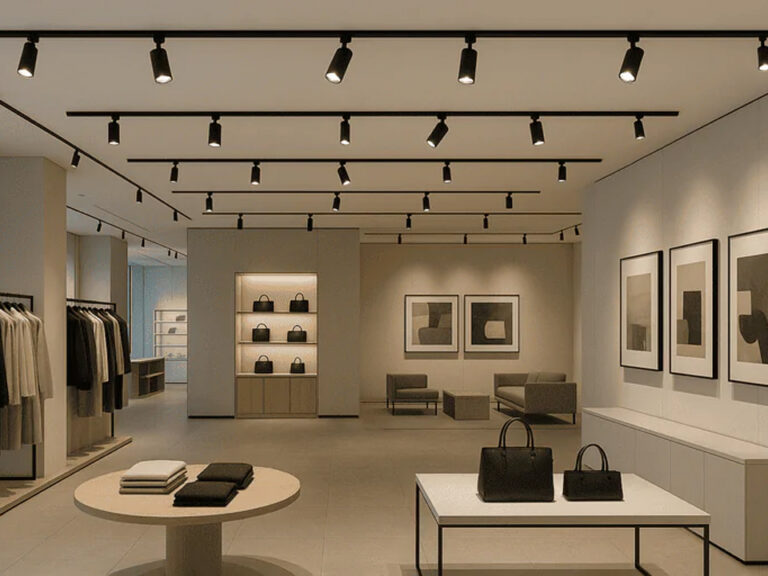
For adjustable retail and showroom layouts, LED track lighting is often a better fit than fixed downlights because merchandise changes, displays move, and beam direction matters.
9. How do you control glare?
Ask about UGR, cut-off angle, reflector depth, lens material, honeycomb accessories, recessed optics, and anti-glare trim options.
Bright is easy. Comfortable is harder.
If a supplier only says “high lumen,” they are talking like a catalog seller, not a lighting partner. In offices, hotels, reception zones, and boutiques, glare control can matter more than another 10 lm/W.
10. What thermal design protects lumen maintenance?
Ask about aluminum grade, heat sink structure, junction temperature, PCB material, thermal paste, ventilation, and whether testing was done in open air or inside a realistic fixture body.
Heat kills LEDs slowly. That is why cheap luminaires can look fine for three months and then slide into ugly depreciation.
11. What is your quality control process before shipment?
This question should produce a process, not a slogan. Look for IQC, IPQC, aging tests, functional tests, visual inspection, label checks, packaging drop tests, and batch traceability.
Meagree’s LED lighting quality control process describes incoming inspection, in-process QC, pre-shipment verification, batch traceability, ISO-managed workflows, and 96-hour aging verification, which are the kinds of control points buyers should demand from any serious supplier.
12. Can you share your sample approval workflow?
The best commercial LED lighting supplier checklist should include sample sequence. Ask for engineering sample, appearance sample, functional sample, photometric sample, golden sample, and pre-production sample.
One sample is not enough if you are ordering 500+ units for phased rollout.
13. Will the mass production batch match the approved sample?
This sounds obvious. It is not.
Ask whether the supplier locks LED chip bin, driver model, housing finish, lens material, CCT, CRI, beam angle, label, packaging, cable, connector, and installation accessories after approval.
Then ask where that lock is written.
14. What certifications apply to my destination market?
For U.S. projects, ask about UL, ETL, FCC, DLC, and Title 24 where relevant. For EU projects, ask about CE, RoHS, ErP, ENEC, and REACH where relevant. For outdoor fixtures, ask about IP65, IP66, IK08, IK10, salt spray, surge protection, and waterproof testing.
Do not accept certificate screenshots without matching model numbers.
15. Have your products ever been recalled, rejected, or failed compliance testing?
This is uncomfortable. Ask it anyway.
The CPSC announced a 2026 recall of High Bay Linear LED light fixtures due to fire hazard; the recalled products were sold from January 2016 through June 2025 for $50 to $350, and the firm had received one report of a fixture catching fire. That is exactly why buyers must ask about failure history, retaining pins, thermal design, component traceability, and corrective-action records. See the CPSC high bay LED fixture recall.
16. What is the warranty, and what is excluded?
A “5-year warranty” can mean almost anything. Ask whether it covers drivers, LEDs, finish, clips, sensors, controls, emergency battery packs, outdoor corrosion, labor, freight, and replacement units.
Also ask what happens if the same defect appears across 8%, 15%, or 30% of a batch. A warranty that handles one failed unit but ignores systemic defects is procurement theater.
17. What is your MOQ, lead time, and reorder stability?
Ask for sample MOQ, trial order MOQ, regular MOQ, production lead time, peak-season lead time, and reorder lead time.
Meagree’s commercial category pages state typical 15–20 day lead time for regular models and repeat orders after sample approval, which is the kind of number buyers should verify against project deadlines, inspection time, sea freight, customs, and phased site access.
18. Can you support OEM/ODM work without losing control of quality?
If you need private-label SKUs, custom housing finishes, modified optics, special packaging, barcodes, manuals, or new mold development, ask whether the supplier has an engineering team or only a sales team.
For custom programs, review commercial LED lighting OEM/ODM capabilities and ask similar questions of every supplier: R&D headcount, mold options, 3D prototyping, optical design, compliance support, and scalable manufacturing. Meagree states its OEM/ODM workflow is backed by a 10-engineer commercial lighting R&D team and supports testing, certification pathways, custom lenses, reflectors, diffusers, PCB layout, and driver integration.
19. Who handles technical support after installation?
Ask for the name, channel, response time, and escalation route. Salespeople close orders. Engineers solve failures.
If the supplier cannot support wiring questions, dimming compatibility, replacement parts, installation clips, photometric files, and troubleshooting, then your local installer becomes the unpaid engineering department.
20. What information do you need from me to quote correctly?
A good LED lighting distributor or manufacturer will ask about application, ceiling height, beam angle, CCT, CRI, dimming, voltage, finish, quantity, installation method, market, certification needs, and project timeline.
Commercial LED Lighting Supplier Checklist: What to Ask and What to Demand
Supplier Question Area
What You Should Ask
Good Answer
Red Flag
Factory identity
Are you a manufacturer, trader, or hybrid?
Clear production scope, factory address, process photos, QC workflow
“We cooperate with many factories” with no detail
Photometrics
Can you provide LM-79, IES, and LDT files?
Files match exact model, wattage, CCT, beam angle
Generic file from a similar fixture
LED life
What supports the 50,000-hour claim?
LM-80 + TM-21 + L70 explanation
“Our chip brand is famous”
Color quality
What are CRI, R9, CCT, SDCM?
CRI 80/90/95 options, R9 available, 3-step or 5-step SDCM
“Warm white or cool white only”
Driver
Which driver is used?
Brand, model, PF, THD, dimming protocol, warranty
Driver may change after sample
QC
What happens before shipment?
IQC, IPQC, aging, final inspection, batch traceability
Only visual inspection
Warranty
What is excluded?
Written terms for driver, LED, finish, freight, batch defect
“Don’t worry, we will support you”
Delivery
Can you hold repeat-order consistency?
Locked BOM, golden sample, reorder SKU control
Similar parts used “depending on stock”
My Unpopular Buying Rule: Never Reward Vague Confidence
Some suppliers are smooth. Too smooth.
When I evaluate a commercial LED lighting supplier, I care less about how quickly they say “yes” and more about how carefully they define the limits of that yes. A strong supplier will push back. They will ask for ceiling height, lux target, beam angle, dimming system, site voltage, certification market, installation method, and maintenance access.
That friction is useful.
It means someone is thinking.
A weak supplier sells one fixture into every problem. Office? Same downlight. Boutique? Same downlight. Hotel corridor? Same downlight. Gallery? Same downlight with a different photo.
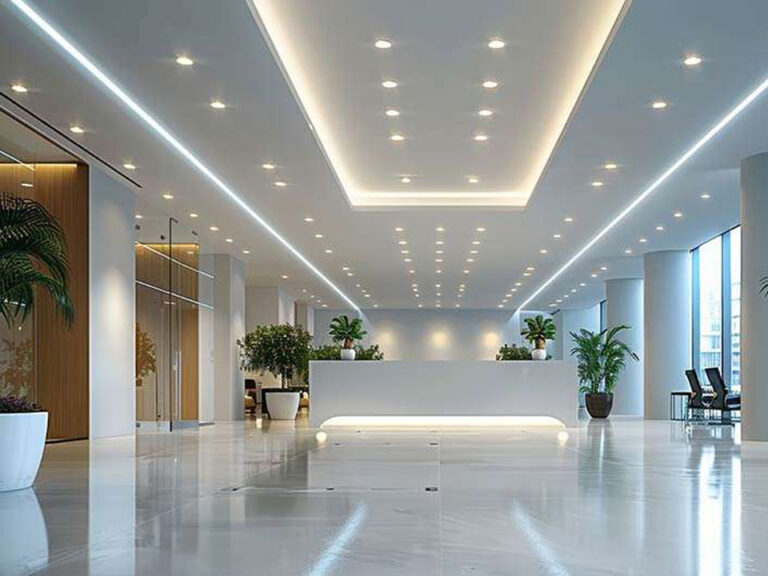
For offices, corridors, and modern interiors, LED linear lighting may solve uniformity and ceiling-line design better than spotlights. For retail display, gallery work, jewelry cases, and merchandise focal points, track lights or spotlights often carry the visual load. For ambient ceiling applications, LED downlights may be the better base layer.
The best commercial LED lighting supplier does not push one answer. It narrows the right answer.
Questions to Ask Before Paying the Deposit
Before you send money, ask for these files and confirmations in writing:
Final model number and wattage
CCT, CRI, R9, and SDCM target
Beam angle and optical accessory list
Driver brand, model, PF, THD, and dimming protocol
Input voltage and surge protection
LM-79, LM-80, TM-21, IES, and LDT files where available
CE, RoHS, FCC, UL, ETL, DLC, or market-specific certificates where required
BOM lock or approved substitute policy
Sample approval photos and test records
Warranty terms with exclusions
Packaging method and carton markings
Lead time, inspection window, and shipping terms
That list may feel demanding.
Good.
Professional buyers are not difficult; they are expensive to disappoint.
FAQs
What questions should I ask a commercial LED lighting supplier before ordering?
A commercial LED lighting supplier checklist is a structured set of technical, compliance, production, warranty, and delivery questions that helps buyers verify whether a supplier can deliver stable luminaires, repeatable batches, correct documents, and safe project support before any deposit or purchase order is issued. Start with manufacturer identity, photometric files, driver model, CCT/CRI tolerance, dimming compatibility, QC process, certification status, warranty exclusions, lead time, and batch traceability.
How do I choose a commercial lighting supplier for a project?
Choosing a commercial lighting supplier means selecting a partner that can prove fixture performance, compliance readiness, production control, technical support, and reorder consistency for the exact project application, not merely the supplier offering the lowest unit price or the fastest sample promise. Compare suppliers by documentation quality, engineering depth, response accuracy, QC workflow, warranty language, and their ability to match fixture type to real site conditions.
What documents should an LED lighting distributor provide?
An LED lighting distributor should provide model-specific technical documents that confirm electrical, optical, safety, compliance, and installation details, including datasheets, IES or LDT files, LM-79 reports where available, LM-80/TM-21 support, driver specifications, installation instructions, certificate copies, warranty terms, and packing information. If the distributor cannot connect those files to the exact SKU being quoted, the buyer should treat the offer as incomplete.
Why should I request samples before ordering commercial LED lighting fixtures?
Requesting samples before ordering commercial LED lighting fixtures allows the buyer to verify real brightness, beam angle, glare control, housing finish, driver behavior, dimming stability, installation details, packaging quality, and color consistency before committing to bulk production. A sample is not proof by itself, but it becomes powerful when tied to a golden sample, locked BOM, test record, and written mass-production agreement.
Is the best commercial LED lighting supplier always the factory?
The best commercial LED lighting supplier is not always the factory, but the supplier must control enough engineering, documentation, QC, and after-sales responsibility to protect the buyer from product mismatch, batch inconsistency, compliance problems, and warranty disputes. Some distributors are excellent because they curate and verify factories; some factories are poor because they lack service discipline. Control matters more than the label.
Final Thoughts: Ask Hard Questions Before the Supplier Owns Your Timeline
The right supplier will not fear these 20 questions.
In fact, a serious commercial LED lighting supplier should welcome them because informed buyers waste less time, approve samples faster, and reorder with fewer surprises. The weak suppliers will complain that you are asking too much. Let them complain. Your project budget, installation schedule, fire risk, warranty exposure, and brand reputation are not there to protect a supplier’s feelings.
So here is the next step: use this article as your commercial LED lighting supplier checklist, mark every unanswered item, and send your target fixture type, quantity, CCT, CRI, beam angle, dimming requirement, certification market, and project deadline to a supplier that can respond with real documents. If you need factory-direct support for retail, office, hospitality, or OEM/ODM lighting programs, start with Meagree’s commercial LED lighting quote and project support page and ask the uncomfortable questions before you order.