Vous n'avez toujours pas trouvé la bonne solution d'éclairage commercial ? Parlez-en à notre équipe de projet.
Si vous avez consulté le site web ou si vous avez déjà discuté des options avec le service des ventes, mais que vous avez encore besoin d'une orientation plus claire, envoyez votre demande ici. Notre équipe examinera votre application, les spécifications visées et les contraintes du projet, puis vous répondra en vous indiquant la marche à suivre : ce qui convient, ce qui doit être confirmé et la voie la plus rapide pour obtenir un devis et des fichiers prêts à l'emploi pour votre projet.
Examen direct de votre application, des spécifications et des contraintes du projet pour un devis plus clair.
Correspondance des produits en termes d'angle de rayonnement, de CCT / CRI, de pilotes, de gradation et d'options de contrôle.
Soutien à la documentation du projet, y compris les feuilles de coupe, les notes de câblage et les fichiers IES / LDT lorsqu'ils sont disponibles.
Conseils OEM / ODM pour les étiquettes, l'emballage, la finition du boîtier et les exigences de la marque privée.
Obtenir un devis rapide pour l'éclairage LED commercial
Conçu pour les concepteurs, les architectes, les entrepreneurs, les grossistes et les acheteurs de projets. Faites-nous part de votre application, de la quantité et des spécifications souhaitées pour obtenir des prix directs, des conseils sur les délais de livraison et une assistance prête à l'emploi pour les projets aux États-Unis et dans l'Union européenne.
Options prêtes à l'emploi : faisceau / optique, cibles CCT / CRI / SDCM, pilotes, gradation et intégration des commandes.
Documentation du projet : feuilles de coupe, dessins et fichiers IES / LDT, le cas échéant.
Support OEM / ODM : UGS, emballages, étiquettes, manuels et étiquettes prêtes à l'emploi pour les codes-barres sous marque privée
Qualité stable pour les déploiements : UGS répétables, points de contrôle du contrôle qualité et approvisionnement modulable pour les appels d'offres et les réapprovisionnements.
NDA disponible sur demande pour les dessins détaillés et les dossiers de projet
Hospitality Downlighting That Feels Premium Instead of Harsh
When a hotel spends heavily on textured plaster, walnut joinery, and carefully selected upholstery, then positions exposed downlight apertures across a guest’s reclining sightline, the lighting can undermine every material decision before anyone touches the bedside controls.
Why pay for beautiful surfaces if the ceiling keeps demanding attention?
I judge hospitality lighting by what guests can comfortably see: another person’s face, the room-service menu, the texture of a wall, the route to the bathroom. A ceiling full of bright circles tells me very little about those outcomes.
My position is straightforward: premium downlighting starts with controlling the source, then placing useful light where the room needs it. Wattage comes later.
Why Hospitality Downlights Can Make an Expensive Room Feel Cheap
“Harsh” is an imprecise complaint with several possible causes. The source may be too bright in the field of view. The contrast between the aperture and its surroundings may be excessive. Reflections may place another bright image on a polished table.
The Society of Light and Lighting identifies source luminance, apparent size, background brightness, and position relative to the observer as factors in discomfort glare. That explains why evaluating a fitting while standing underneath it misses part of the problem. Guests also sit, recline, and look across rooms.
I would therefore review a lighting layout from the pillow, the dining chair, and the reception queue before approving the ceiling plan.
Imagine a guest room with a downlight directly above the bed’s foot. It may illuminate the floor effectively while presenting an exposed source to someone reading against the headboard. Moving the fitting, changing its optics, or providing a separate reading light deserves consideration before simply lowering its output.
A dimmer cannot correct every placement mistake.
Specify Glare Control Beyond the “Anti-Glare” Label
“Anti-glare” is a claim to investigate.
For low-glare LED downlights, I would request the optical section, shielding geometry, photometric file, and a physical sample. Recess depth matters, but so do the reflector, lens, aperture, and direction from which the source becomes visible.
A quoted Unified Glare Rating also needs context. UGR calculations include the observer’s position and the surrounding installation; a catalogue statement such as “UGR <19” should prompt questions about the calculation conditions. It does not establish comfort from every chair in every room.
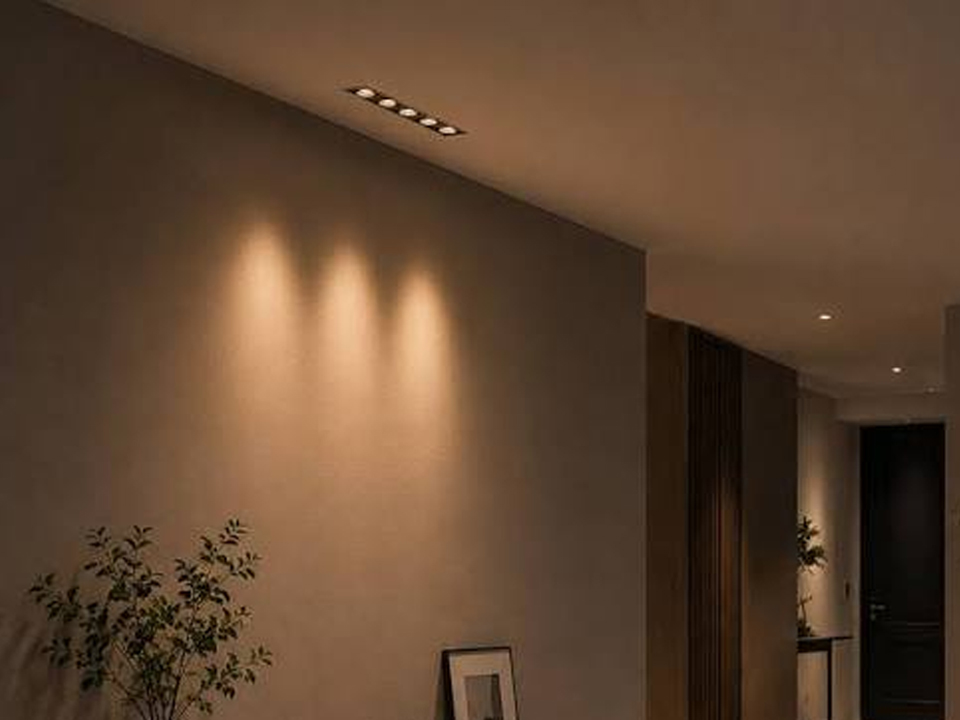
Meagree's 10W deep recessed downlight for hotel guest rooms is described as placing the source deeper into the ceiling and providing high color rendering. Those are relevant characteristics to investigate during selection.
But I would still ask for the numerical CRI, delivered lumens, beam options, driver specification, and supporting test documents. “High CRI” is not a complete color specification, and a product description is not an installed-room assessment.
My acceptance test would be practical: install the proposed fitting at the intended height, reproduce the important viewing positions, and assess it with the actual finishes.
Warm Light Needs Accurate Color and Reliable Dimming
A warm-looking source can still render materials poorly.
Correlated color temperature, or CCT, describes the appearance of the light. Color rendering describes what that light does to objects. The distinction matters when selecting lighting for faces, food, artwork, and expensive finishes.
The September 2024 LED Lighting and Controls Guidance for Federal Buildings explains that conventional CRI uses eight color samples, while TM-30 evaluates 99 and provides information about fidelity and saturation. I would request the fuller report when color appearance is central to the design.
For guest-facing interiors, my starting brief would generally include CRI Ra ≥90, with R9 and TM-30 data available for review. That is a proposed purchasing criterion, not a claim that every hospitality space requires the same specification.
Then there is dimming.
The U.S. Department of Energy describes warm dim products that typically begin around 2700–3000K and become warmer as output falls, sometimes approaching 1800K. It also warns that some implementations can render colors poorly near the bottom of their dimming range.
So I would evaluate warm dim downlights using skin tones, food, fabrics, and timber at the actual evening setting.
Test the controls.
A fitting that behaves beautifully at full output can still be unsuitable for a restaurant if its driver and dimmer produce flicker, abrupt transitions, or dropout during the dinner scene; DOE specifically identifies driver and dimmer behavior as relevant to LED flicker.
What use is a sophisticated control panel if the last part of the dimming range is unusable?
I would ask suppliers to demonstrate the proposed driver, controller, and circuit load together, including startup at the lowest intended setting.
Give Guest Rooms, Corridors, and Restaurants Different Lighting Jobs
I would resist a single downlight schedule copied across an entire hotel. The spaces ask different things of the lighting.
Guest rooms need several independently useful functions. My layout would separate general illumination, bedside reading, wardrobe visibility, and a gentle nighttime route. Recessed hotel lighting should support those tasks without making every activity depend on the same ceiling circuit.
Le 6W recessed ceiling spotlight for hotel interiors provides another product category to assess where focused ceiling lighting is appropriate. Its published positioning includes hotel rooms and circulation spaces, but the required output and spacing still need project calculations.
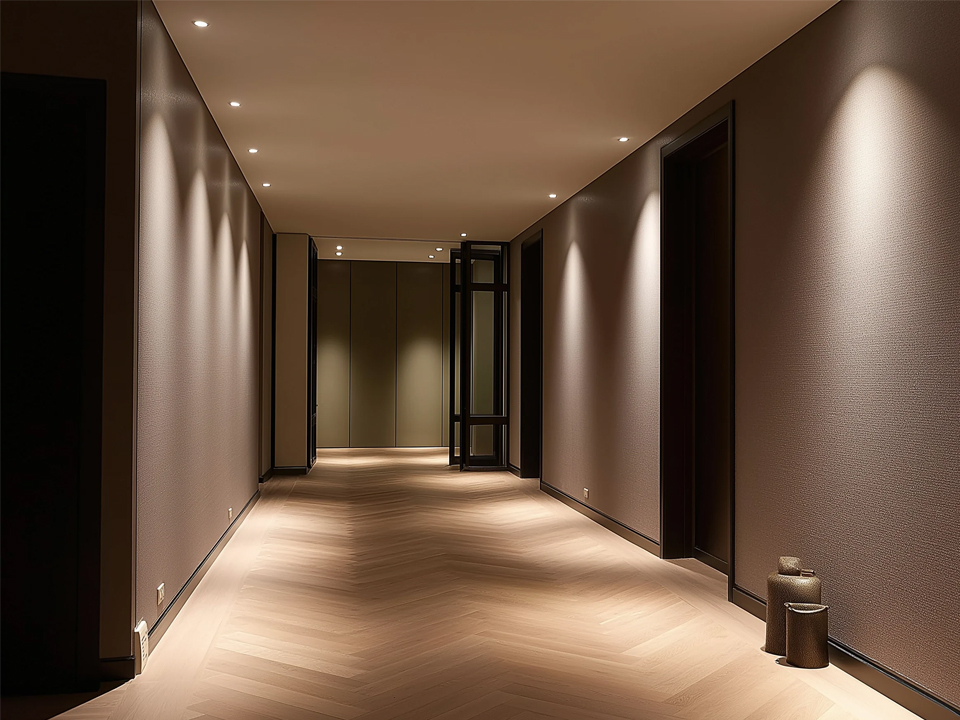
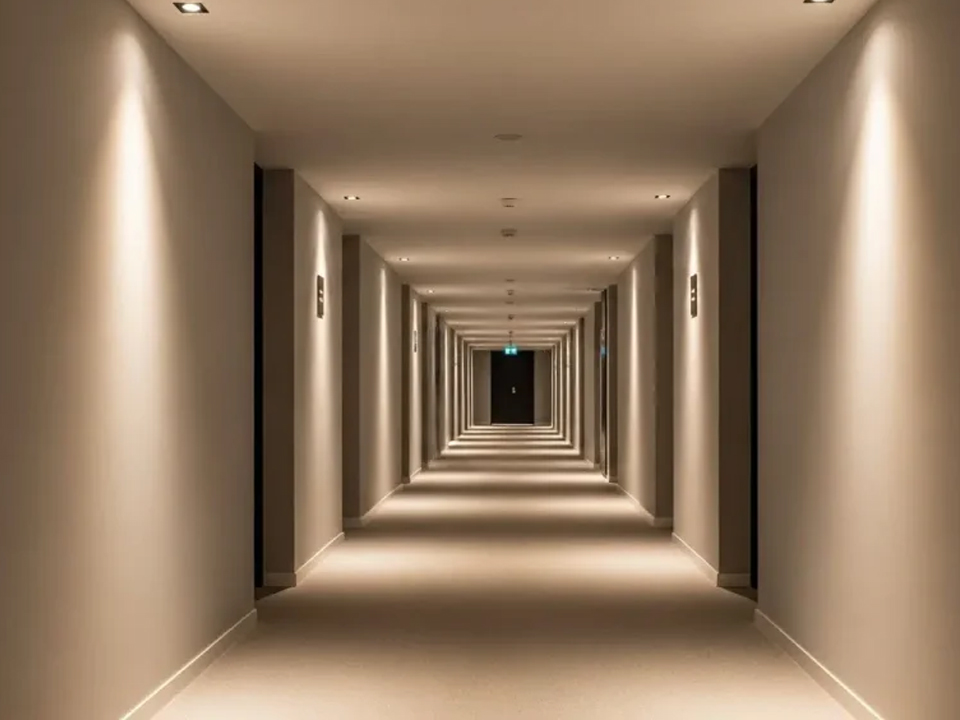
Corridors need legible routes and comfortable transitions. I would evaluate doors, room numbers, lift entrances, and the view along the corridor—not just readings directly beneath fittings.
Restaurant downlighting needs careful aiming and separate scenes. I would test the table surface, seated faces, glassware reflections, and the surrounding brightness together. Cleaning and setup should have their own usable scene.
For decorative emphasis, the 8W recessed spotlight for hotel accent lighting is presented for artwork, reception details, and architectural features. That makes it a candidate for an accent layer, subject to confirming its beam and aiming capabilities.
The purchasing mistake is assigning every fixture the same job because the trims match.
What the 2024 Evidence Actually Supports
Energy claims deserve the same scrutiny as glare claims.
In its February 1, 2024 announcement, the U.S. General Services Administration reported that lighting accounts for approximately 10–25% of building electricity use, depending on building age and lighting system, and that LED conversions typically save 50% against a fluorescent baseline. Those are broad building figures, not a forecast for a particular hotel.
Two projects recognized by DOE’s Integrated Lighting Campaign in 2024 illustrate the value of evaluating lighting and controls together:
8600 Glenoaks, Los Angeles: Circuit-level controls managed 256 common-area fixtures, including 210 interior fixtures and 46 exterior fixtures. DOE reported an energy-consumption reduction exceeding 50% for the project.
Phoenix Convention Center & Venues, Arizona: A retrofit covering exhibit halls, ballrooms, meeting rooms, and public spaces replaced more than 15,000 existing fixtures. DOE reported more than $500,000 in annual savings, including operational savings, alongside centralized controls, scheduling, and dimming.
Neither project proves that a particular hotel downlight feels luxurious. The evidence supports a narrower purchasing argument: operating schedules, controls, maintenance, and the existing baseline belong in the financial assessment.
Here is a transparent illustration. Reducing 100 fittings from 12W to 10W, at 4,000 operating hours annually, saves 800 kWh per year. At an assumed $0.15/kWh, that is $120 annually, before considering controls or other effects.
I would not compromise the guest-room mock-up to chase that wattage difference without first understanding the full cost and performance consequences.
A Specification Table for Hospitality Lighting Procurement
These are proposed review criteria. Confirm final values through the design brief, applicable requirements, calculations, and an installed sample.
Whether servicing requires damage to finished ceilings
I would attach the approved sample’s configuration to the purchase order: optic, CCT, finish, driver, and control interface. “Equivalent” needs a defined meaning before substitutions begin.
FAQs About Hospitality Downlighting
What makes hospitality lighting feel premium instead of harsh?
Premium hospitality lighting combines shielded light sources, balanced brightness, accurate color rendering, and responsive dimming, with fixtures positioned around how guests sit, move, read, and dine so that the room’s materials and useful visual tasks receive attention without uncomfortable brightness dominating normal sightlines.
My first review would cover the occupied room, with furniture and finishes in place.
How do you reduce glare in hospitality lighting?
Reducing glare in hospitality lighting means limiting uncomfortable source brightness within guests’ sightlines through suitable shielding, fixture placement, controlled output, and balanced surrounding brightness, while checking seated and reclining views and reflections from glossy surfaces instead of relying solely on a product’s anti-glare label.
I would make those viewing positions part of sample approval.
What are warm dim downlights?
Warm dim downlights are LED fixtures that reduce their correlated color temperature as light output decreases, producing an increasingly warm appearance from a single dimming action, with some products moving from approximately 2700–3000K at full output toward 1800K at low output, depending on their design.
Confirm the actual color curve and assess the lowest intended operating scene.
What are the best downlights for luxury hotels?
The best downlights for luxury hotels are fixtures whose optics, delivered output, color quality, dimming behavior, and maintenance provisions suit the specific room and control system, with documented performance and an approved installed sample demonstrating that guests can comfortably use the space from its intended viewing positions.
I would shortlist products by those requirements before comparing unit prices.
Make the Room Sample the Buying Decision
Send Meagree the ceiling height, furniture plan, finishes, control requirements, and quantities. Request photometric files, numerical color data, driver details, and samples for the proposed guest-room, corridor, and accent fittings.
Then approve one representative installation under both daytime and evening scenes.
Buy the configuration that passes that review—and record exactly what passed.